
Diving being done, and thoughts of early home going having been dashed, we embarked with our hired driver/guide Dewa to see some of Bali and eventually end up at our hotel.
Leaving the airport at Denpasar, he first took us through the tourist district of Kuta. This was where the famous terrorist nightclub bombing took place back in 2002 (one year, one month, and one day after 9/11). We saw the memorial erected at the site, but didn't stop to spend time there. Our main reaction to Kuta was that we were really glad we had elected to stay elsewhere. Didn't really need the chain stores and nightclubs that could be in any tourist beach town in the world.
But we had expected this. Our friend Sharon had recommended not only that we hire Dewa, but that we spend our few days in something more like the real Bali, so we're in Ubud, about 45 minutes north of the tourists. The streets are narrower, the shops are smaller and have local flavor instead of designer labels. And it's really rather quiet.
On the drive up, we stopped at several places, including both stone and wood carving places and a small, local temple. Bali is known for both its carving crafts and its batik cloth, as well as its Hindu temples and dancing. The carvings are just amazing, even though we know they're produced in quantity for the tourist market. It is really high-quality stuff.
The temple was interesting. It's quite old, and constantly being renovated. But it has the sincere feel of a local church. Much less pretense than temples we visited in Fiji, for example.
We stopped for lunch at a local restaurant. Their pizza oven is in the stomach of a large carved stone turtle (wish I’d gotten a picture!). The dining room is on the top floor, open on all sides so you can see the surrounding country, which is largely rice fields. It was very calm and peaceful, and the food authentic and tasty (we skipped the pizza and had curry and fried noodles with veggies).
Then we stopped to check into our hotel, the Tunjung Mas Bungalows. It's a small place (6 bungalows, I believe), but quiet and lovely, easy walking distance to town. The name translates as "Golden Lotus Flower," and there are lots of lovely flowers on the grounds.
We then visited the Monkey Forest, where there are, unsurprisingly, about 300 macaque monkeys in residence. They're a hoot, running all about doing monkey business and delighting the tourists. Interestingly, there is a Hindu cemetery in the middle of the forest on a hill, and there was a community burial going on which we watched some of. I was not aware that in Bali, at least, they bury their dead for a while, then eventually exhume them for a mass cremation. The purpose is to save the expense of individual funerals.
After visiting Dewa's shop and his wife's, too, we crashed at the hotel for a bit before heading off to dinner at Bebek Bengil, which translates to the Dirty Duck Diner. It's a lovely setting, built on what used to be rice fields. It's extensive, but doesn't feel big or crowded, as the facilities are really well designed. There is flowing water and fountains throughout, and tables that feel private. The food was quite tasty, and we both tried cocktails made with arak, the local liquor. Rather a strong flavor, so we switched to Bintang, the local pilsner beer.
Whew! Long, busy day, and we have to get up in the morning to go river rafting and elephant riding before Jan's spa appointment and Balinese dancing at the old palace. Hey, short visit, no time to waste!
Thursday, September 25, 2008


Last Seven Seas Thoughts
Just wanted to put down a few more thoughts about the recently-competed diving aboard the Seven Seas before I start scribbling about Bali.
First, I have to say that the Seven Seas was a very nice, very well-run operation. Mark and his crew did an excellent job of making us all feel welcome, comfortable, and safe. The boat itself is lovely, and the dive crew and kitchen crew were all top-notch. Good food (self-serve is nice), friendly service, and all well maintained. I believe we had one of the smallest cabins on the boat, but it was quite adequate. We stored our luggage and some other things on the unused upper bunk. Getting dressed with two of us was challenging at times, but we managed.
And the diving was really, really good. Graham made sure we got a taste of all the different environments available around Komodo, and Tomi and Bram and the boat drivers made sure we saw the key things and got to and from the sites quickly and easily. Best of all, I felt like Mark and his crew had a good, positive working relationship. I didn't sense any of the labor-management tensions that often creep into dive-boat operations.
It was hard to say goodbye, but after ten days and about 35 dives, we were ready to think about heading home.
We'd had some thoughts about trying to get home sooner, rather than spending an extra four days in Bali, but Continental Airlines assured us that the one flight leaving before ours on Sunday, tonight, was already overbooked considerably. So we headed off for a little mini-adventure in Bali.
First, I have to say that the Seven Seas was a very nice, very well-run operation. Mark and his crew did an excellent job of making us all feel welcome, comfortable, and safe. The boat itself is lovely, and the dive crew and kitchen crew were all top-notch. Good food (self-serve is nice), friendly service, and all well maintained. I believe we had one of the smallest cabins on the boat, but it was quite adequate. We stored our luggage and some other things on the unused upper bunk. Getting dressed with two of us was challenging at times, but we managed.
And the diving was really, really good. Graham made sure we got a taste of all the different environments available around Komodo, and Tomi and Bram and the boat drivers made sure we saw the key things and got to and from the sites quickly and easily. Best of all, I felt like Mark and his crew had a good, positive working relationship. I didn't sense any of the labor-management tensions that often creep into dive-boat operations.
It was hard to say goodbye, but after ten days and about 35 dives, we were ready to think about heading home.
We'd had some thoughts about trying to get home sooner, rather than spending an extra four days in Bali, but Continental Airlines assured us that the one flight leaving before ours on Sunday, tonight, was already overbooked considerably. So we headed off for a little mini-adventure in Bali.
Wednesday, September 24, 2008
Boats to Build
 We did a really interesting little tour of a village known for building boats. Unfortunately, I seem to have neglected to write down the name of the village, so I hope one of my trip mates can fill in that gap.
 Anyway, they build boats in the traditional Indonesian way, which is to say, by hand, from wood. They use a few metal bolts in key locations, but for the most part, it’s wooden pegs, driven by wooden hammers. They do use an electric drill, however.
 Some of the fascinating aspects of the process are that, unlike Western ship-building, they build the hull's planking first, then individually shape the ribs to fit the planks. By hand. And nearly everything about the process is handmade of wood, like the ladders down into the boat, the roof over the hull that shelters the workers (and the boat) from sun and rain. I hope my pictures can convey some of that.
 We climbed up a ramp to look into one of the hulls that was in process. It’s not nearly as rickety as it appears, though it is a bit steep, with not much in the way of a railing. Depending on who you ask, the four guys building this boat have been at work on it for either one or two years so far. There’s still much to do, including plugging the gaps between the planks and adding decking. Once the hull is complete, they have to launch the boat and tow it to another island where it gets its engine and other finishing.
The village itself was pretty interesting. We stopped by one house and saw people weaving. We walked through much of the town, followed by a horde of children. One teenage boy was talking to his girlfriend on his mobile phone so she could hear us speaking English. Several people in our group had brought gifts for the children of the village, including pencils and books. I thought a riot was going to break out over the package of pencils. It’s hard to believe how much of a difference such a thing can make in a kid’s life, but we later had one little girl showing off her pencil and just beaming.
We saw lots of motorbikes in town, but only a few cars. The biggest, fanciest house belongs to one of the big boat-builders, naturally. That is really the business of the village. But we saw other interesting stuff, like a shack with a hand-painted sign that reads "Rental Playstation." For a place with little apparent electricity, that seemed odd.
Poking About
Diving (and the visit to Komodo National Park) is winding down. Josh is editing his trip video, which promises to be splendid, as always. This morning we visited an interesting site where a big boulder from the top of the reef recently (like 12-18 months ago) rolled down to about 90 feet. In the wake of its roll, there are a lot of small rocks in the black sand. And among them, more nudibranchs than I can describe. Graham says it's the premier nudibranch dive in all Asia.
It's funny how we can get from watching schools of big fish one dive to poking under rocks for tiny slugs the next. Truly, I enjoy both. One of the joys of looking so closely at small things is that you notice more and more detail the longer you look. You might start out looking for a pretty nudibranch and notice a tiny shrimp or a well-hidden crab. Much like life in general, I suppose: When you're open to seeing things, you might see things you didn't expect.
Volcano update: The cone was shrouded in clouds this morning. Unfortunately I didn't get to take a picture, so you'll have to take my word for it.
It's funny how we can get from watching schools of big fish one dive to poking under rocks for tiny slugs the next. Truly, I enjoy both. One of the joys of looking so closely at small things is that you notice more and more detail the longer you look. You might start out looking for a pretty nudibranch and notice a tiny shrimp or a well-hidden crab. Much like life in general, I suppose: When you're open to seeing things, you might see things you didn't expect.
Volcano update: The cone was shrouded in clouds this morning. Unfortunately I didn't get to take a picture, so you'll have to take my word for it.
Tuesday, September 23, 2008
I Don't Know
Good diving today. We're still at Sangeang Island, and this morning conditions were very mild, so we got to dive again at Deep Purple and Bubble Reef in the morning with essentially no current. Then an afternoon dive at Sangeang Rocks, where we bimbled (Graham's term for it) around the rocks looking for critters. I found lots of little shrimps and crabs, some little nudibranchs, and a few little fish. Lots of baby and juvenile fish on all the dives; this is a great time of year for that.
 As we rode the skiff back to the boat, we noticed the smell of smoke in the air, and someone pointed out that the top of the volcano is smoking a bit. Last night coming back from the night dive we had noticed an orange glow up there, too. No notion that things might blow, but it's kind of fun being next to an active volcano.
UPDATE: As the sun went down, we could see the orange glow up near the top of the volcano. There was some debate over whether we were seeing lava or a fire, but Graham assures us there is nothing up there that would burn (anymore), so we concluded that it was lava glowing. Kind of eerie and yet cool.
 As we rode the skiff back to the boat, we noticed the smell of smoke in the air, and someone pointed out that the top of the volcano is smoking a bit. Last night coming back from the night dive we had noticed an orange glow up there, too. No notion that things might blow, but it's kind of fun being next to an active volcano.
UPDATE: As the sun went down, we could see the orange glow up near the top of the volcano. There was some debate over whether we were seeing lava or a fire, but Graham assures us there is nothing up there that would burn (anymore), so we concluded that it was lava glowing. Kind of eerie and yet cool.
Monday, September 22, 2008
Small and Large
Fascinating deep dive this morning at Sangeang Island, a relatively-recently active volcano with lots of black sand. We dropped down about 110 feet into a canyon full of fan corals and such. I found a huge scallop on the wall, probably the largest I've ever seen. Working with our friend Sharon, I also spotted a tiny pygmy seahorse on one of the fan corals.
Probably the oddest find was a dive mask one of our friends found sitting on top of the reef. The cover on the mask strap had the logo of our local dive shop back home, Bamboo Reef! We decided to leave it there. I'm hoping someone can snap a picture of it when we go back later this morning.
Probably the oddest find was a dive mask one of our friends found sitting on top of the reef. The cover on the mask strap had the logo of our local dive shop back home, Bamboo Reef! We decided to leave it there. I'm hoping someone can snap a picture of it when we go back later this morning.
Sunday, September 21, 2008
Life on the Reef
Today we're at Banta Island, not technically part of Komodo National Park, but just outside. The water is warmer again, and the dive site we're currently visiting, called K2, is quite spectacular. The late morning dive was particularly good, with lots of light, warm water, and just about the whole range of reef life on display. As we swam along, we could feel different currents blending, which is usually a signal that much will be happening. The different currents bring in nutrients, and that was certainly in evidence.
Many corals that are usually only open at night were fully out and feeding. Schools of reef fish that are normally lurking in or near their coral homes were out in the open, gorging themselves on yummy planktonic lunches. From the perspective of our photographer friends, the visibility isn't all they'd like, but the amount of life on display more than makes up for it.
At one point I spotted a couple of groupers, so I watched, thinking I might get a repeat or a variation on yesterday's courtship dance. Instead, one took off almost immediately, headed down the reef. As I pointed out the remaining one to my buddy, he spooked a little, and moved away. Almost instantly, the “rock” above him moved, revealing itself to be a fairly good sized, very well camouflaged, octopus!
I tried to get the octopus to play, but it only wanted me to go away. Doug came and got a few pictures, but by the time Andrew and his video camera got there, the octopus wanted nothing more than to hide. He found a rather deep hole in the reef, where I could barely see a tentacle and an eye, so I figured we were done.
Many corals that are usually only open at night were fully out and feeding. Schools of reef fish that are normally lurking in or near their coral homes were out in the open, gorging themselves on yummy planktonic lunches. From the perspective of our photographer friends, the visibility isn't all they'd like, but the amount of life on display more than makes up for it.
At one point I spotted a couple of groupers, so I watched, thinking I might get a repeat or a variation on yesterday's courtship dance. Instead, one took off almost immediately, headed down the reef. As I pointed out the remaining one to my buddy, he spooked a little, and moved away. Almost instantly, the “rock” above him moved, revealing itself to be a fairly good sized, very well camouflaged, octopus!
I tried to get the octopus to play, but it only wanted me to go away. Doug came and got a few pictures, but by the time Andrew and his video camera got there, the octopus wanted nothing more than to hide. He found a rather deep hole in the reef, where I could barely see a tentacle and an eye, so I figured we were done.
Saturday, September 20, 2008
Love is in the Water
We're south of the equator here (8 degrees or so), which means that it's Spring, and you can certainly tell by the behavior of the critters hereabouts.
We did two dives today at a site called Castle Rock, where there is often a current running ("breezy" or "drafty" and sometimes "gusty," depending on who you listen to). Currents tend to bring in bigger life, and this site is no exception. As we dropped in, we could see numerous white tip reef sharks cruising by. There we lots of trevally jacks, mackerel, and some tuna, too. Some of the mackerel were getting a bit frisky, swimming side-by-side, bumping into each other, getting excited.
After watching that show for a while, we headed up the sea mount to shallower water. There were some really nice corals and lots of fish; pleasant to watch. I spotted a pair of camouflage groupers circling around one another. This was clearly a mating/courting ritual. We watched for a while, and then noticed a much bigger grouper come peeking around the rock, apparently deciding all was going well, and heading off again. I decided this must be the chaperon. After a couple more minutes a third grouper of the same sort, but showing rather different coloration, joined in. One of the others, presumably the female, moved off, and the two others literally faced off, sitting nose-to-nose for a couple of minutes. Then there was a little snapping, some displays of wide-open mouths, and the interloper (I think) moved on. The female returned, and the courting resumed.
One positive thing I noticed this morning was a crown-of-thorns starfish. These are known as a great, voracious pest in many places, and the last time I recall seeing any was on our honeymoon ten years ago in Fiji, where they had devastated quite a number of reefs, practically scraping them bare. We were told at the time that the rise of the crown-of-thorns correlated with the decline of giant clams, which filter enormous amounts of water, including filtering out the eggs of the crown-of-thorns.
Here we have noted quite a few clams, although not the truly huge ones, but they seem to be doing the job of keeping the crown-of-thorns in check. Balance is important.
We did two dives today at a site called Castle Rock, where there is often a current running ("breezy" or "drafty" and sometimes "gusty," depending on who you listen to). Currents tend to bring in bigger life, and this site is no exception. As we dropped in, we could see numerous white tip reef sharks cruising by. There we lots of trevally jacks, mackerel, and some tuna, too. Some of the mackerel were getting a bit frisky, swimming side-by-side, bumping into each other, getting excited.
After watching that show for a while, we headed up the sea mount to shallower water. There were some really nice corals and lots of fish; pleasant to watch. I spotted a pair of camouflage groupers circling around one another. This was clearly a mating/courting ritual. We watched for a while, and then noticed a much bigger grouper come peeking around the rock, apparently deciding all was going well, and heading off again. I decided this must be the chaperon. After a couple more minutes a third grouper of the same sort, but showing rather different coloration, joined in. One of the others, presumably the female, moved off, and the two others literally faced off, sitting nose-to-nose for a couple of minutes. Then there was a little snapping, some displays of wide-open mouths, and the interloper (I think) moved on. The female returned, and the courting resumed.
One positive thing I noticed this morning was a crown-of-thorns starfish. These are known as a great, voracious pest in many places, and the last time I recall seeing any was on our honeymoon ten years ago in Fiji, where they had devastated quite a number of reefs, practically scraping them bare. We were told at the time that the rise of the crown-of-thorns correlated with the decline of giant clams, which filter enormous amounts of water, including filtering out the eggs of the crown-of-thorns.
Here we have noted quite a few clams, although not the truly huge ones, but they seem to be doing the job of keeping the crown-of-thorns in check. Balance is important.
Friday, September 19, 2008
Big Black Fish
A highlight of the afternoon was a dive along a reef that culminated in us "hooking on" to the reef in a strong current while "big, black fish" came to check us out. I'm not entirely clear why the dive guide didn't want to say what kind of big, black fish we might bee seeing. I guess either he didn't want to jinx us, or he wanted the nature of the fish to be a surprise.
In any case, after swimming along the reef for a bit, we swooped up through a gully into shallow water and grabbed onto pieces of dead coral rock. As the current rushed by, we scanned for big, black fish.
And then, they came: Manta rays. At least four of them, about 5-6 feet across. They would swim up through our streams of bubbles, almost close enough that we could touch them. Then they'd open up their mouths and float back on the current, feeding as they went. It was great, and went on, over and over, for about half an hour. We had a blast.
Later, some folks went back to snorkel at the same site. They had some good encounters, but only when there were also divers in the waters. They appear to really like the bubbles. When the divers were gone, the mantas still played and fed in the current, but farther away from the people.
In any case, after swimming along the reef for a bit, we swooped up through a gully into shallow water and grabbed onto pieces of dead coral rock. As the current rushed by, we scanned for big, black fish.
And then, they came: Manta rays. At least four of them, about 5-6 feet across. They would swim up through our streams of bubbles, almost close enough that we could touch them. Then they'd open up their mouths and float back on the current, feeding as they went. It was great, and went on, over and over, for about half an hour. We had a blast.
Later, some folks went back to snorkel at the same site. They had some good encounters, but only when there were also divers in the waters. They appear to really like the bubbles. When the divers were gone, the mantas still played and fed in the current, but farther away from the people.
Here Be Dragons
 This morning we awoke at Komodo Island. After breakfast we took the skiffs over to the visitor center at the park, where we hired guides to walk us around the island. On the walk we saw a lot of deer, a couple of wild pigs, Imperial pigeons, chickens, eagles, and some other birds. But no dragons. We did see some genuine dragon poo, complete with deer hair, so we know they are around and feeding.
As luck would have it, however, there are four big dragons who like to hang out by the kitchen at the ranger station, so they took us over there. It's not the same as seeing them truly in the wild, but they are wild and uncaged. Lovely animals, if a bit slothful this morning.
The island itself, at least the part we hiked, is quite dry ('tis the season)and not particularly diverse. After the obligatory stop at the ranger-station souvenir shop and one other little higher-end gift shop (I so wanted to buy a plush Komodo dragon, but didn't want to carry it home!) we walked through a local market where we were offered carved dragons (many wearing scuba gear), pearls, and some other crafts. Little kids followed us back to the skiff, imploring us to buy some pearls, a necklace, a carving. Or give us your hat, your sunglasses, something. They ultimately seemed pretty pleased with our plastic water bottles.
One of the ongoing difficulties in diving in some of these remote, impoverished areas is how to deal with such requests. We have so much, it seems criminal to leave without leaving something behind. Most of us try to help, and often bring some small gifts for the villagers, but it is always difficult.
I guess I'm slightly disappointed in the dragon encounter. It's cool to have seen them. In some ways the distant spotting of them on the beach the other morning was more satisfying, but both reinforce that we are really in Komodo.
Now back to diving for a bit. Supposed to be lots of fish life hereabouts.
Thursday, September 18, 2008
Good Days and Bad Days

We've spent two days moored in Horseshoe Cove at the southern end of Rinca Island. There are several terrific dive sites within short skiff rides, so the boat stays put, and we get to choose from many options.
The beach right in front of the boat occasionally features a little wildlife. Wild pigs come out to forage (a family of four, at least). We've seen a deer rearing up to eat leaves off a mangrove tree. And...dragons. At least two small Komodo dragons have put in appearances. All too far away for my little camera to register them, but through binoculars they're quite clear.
One afternoon we took a bowl of fish and chicken parts over to the beach to see whether we could entice any dragons to come into camera range. One did poke his nose out onto the beach while we were way down at the other end, but by the time we got back to his area, he was long gone.
While we strolled the beach waiting for dragons, I took the opportunity to shoot some pictures of the trash washed up along the tide line. Ugh. Much as we'd seen in Sian Ka'an preserve in the Yucatan, there was a load of mostly plastic trash all around the high tide line. Rumor has it that cruise ships dump their trash not far off shore. We found lots of food packets, bottles, bottle caps, and just small bits of brightly colored plastic.
Very sad, here in a national park, a World Heritage Site, to find more signs of negligent human activity.
Monday, September 15, 2008
Let the Diving Begin!

Just finished our first dive off the Seven Seas. We're anchored off Wainilu Point on Rinca Island, next door neighbor to Komodo Island. This spot is terrific for critter diving, also known as “muck diving.” We basically just go over a limited area, looking closely for small, often obscure, creatures.
The highlight of the dive for me was finding a little octopus called a "Wunderpus." He was actively hunting, and we even saw him surround and eat a small crustacean (a maneuver known as "tenting"). Apparently they are rather rare, but there he was, just sitting out on the sand!
I suppose I should mention that this is a somewhat unusual dive charter. Organized by our friends Liz and Josh at Undersea Productions, it's a 10-day cruise on the traditional-style Indonesian boat The Seven Seas around Komodo National Park. Along on the trip, in addition to the boat's regular dive crew, is Graham Abbott of Diving 4 Images. Graham is a British ex-patriot who lives in Bali and dives these waters a LOT. He's known for being able to find the critters that photographers and videographers want to capture, so he runs a service for them. Since nearly everyone on this trip (other than us) is shooting either video or stills, this will come in quite handy.
Komodo National Park
We caught a flight this morning from Denpasar, Bali to Labuan Bajo (LBJ) on Flores Island. This is kind of the entry point to Komodo National Park. It's cool to step off the plane into a very small airport covered with giant posters of Komodo dragons. They're close by, somewhere!
Truth be told, the primary motivation for me to come on this trip was not so much the diving (though I'm told it can be spectacular) as the opportunity to see the dragons. I'm not sure what the attraction is, exactly. I know they are the largest living member of the lizard family, I've seen them in at least one zoo (Sydney's Taronga Zoo), and truly, they're not all that inspiring. But I hope that seeing them in their native habitat will be better.
Flying from Bali among all the small islands was quite spectacular. Lots of islands, with amazing variety in size, shape, and vegetation. Very scenic. Indonesia has always struck me as phenomenally diverse and widely distributed. As usual, my history is weak, so I'm quite unclear on how Indonesia came together, but it strikes me that it would be nearly impossible to govern something so large and diverse.
Truth be told, the primary motivation for me to come on this trip was not so much the diving (though I'm told it can be spectacular) as the opportunity to see the dragons. I'm not sure what the attraction is, exactly. I know they are the largest living member of the lizard family, I've seen them in at least one zoo (Sydney's Taronga Zoo), and truly, they're not all that inspiring. But I hope that seeing them in their native habitat will be better.
Flying from Bali among all the small islands was quite spectacular. Lots of islands, with amazing variety in size, shape, and vegetation. Very scenic. Indonesia has always struck me as phenomenally diverse and widely distributed. As usual, my history is weak, so I'm quite unclear on how Indonesia came together, but it strikes me that it would be nearly impossible to govern something so large and diverse.
Friday, September 12, 2008
Sweet!
And we're off! It's the start of yet another dive vacation. Starting off slow and easy, we flew to Honolulu this morning. That's five hours in the air. After one day in Hawaii we'll have 13 hours to fly to Bali, via Guam.
In a flash of extraordinarily poor judgment, we decided to take the shuttle bus to Waikiki. It worked really well for us on a previous visit, but in retrospect, that's because then our hotel was one of the first to drop off, where this time we were closer to the Diamond Head end of things, which was one of the last. So we sat on the bus a long time.
The good news was that when we arrived at our hotel (the Sheraton Princess Kaiulani), they upgraded us to an ocean-view room. About the time she said upgrade, I blurted out “Sweet!” and she paused, typed a few keys, and upgraded us to a suite. So a random homophone paid off! We were on the 28th floor in a corner suite with a nice view of the ocean and beach.
Since we had all that time on the bus, we spent much of it reading tourist brochures, and decided it might be fun to check out Cirque Hawaii. It appears not to be actually affiliated with Cirque du Soleil, but some of the acts were definitely either copies of the real thing. Parts were kind of cheesy (group jump rope, even in black light just isn't all that thrilling). But it was a fun way to spend the evening.
Then we strolled down the street (they were having a kind of street fair/block party) to our dinner reservation at the Hau Tree Lanai restaurant. Tasty dinner, and Danny the sommelier was very helpful and friendly. He pointed us to a very tasty French wine that went well with both of our main dishes: a filet mignon and the avocado-and-crab encrusted mahi mahi.
In a flash of extraordinarily poor judgment, we decided to take the shuttle bus to Waikiki. It worked really well for us on a previous visit, but in retrospect, that's because then our hotel was one of the first to drop off, where this time we were closer to the Diamond Head end of things, which was one of the last. So we sat on the bus a long time.
The good news was that when we arrived at our hotel (the Sheraton Princess Kaiulani), they upgraded us to an ocean-view room. About the time she said upgrade, I blurted out “Sweet!” and she paused, typed a few keys, and upgraded us to a suite. So a random homophone paid off! We were on the 28th floor in a corner suite with a nice view of the ocean and beach.
Since we had all that time on the bus, we spent much of it reading tourist brochures, and decided it might be fun to check out Cirque Hawaii. It appears not to be actually affiliated with Cirque du Soleil, but some of the acts were definitely either copies of the real thing. Parts were kind of cheesy (group jump rope, even in black light just isn't all that thrilling). But it was a fun way to spend the evening.
Then we strolled down the street (they were having a kind of street fair/block party) to our dinner reservation at the Hau Tree Lanai restaurant. Tasty dinner, and Danny the sommelier was very helpful and friendly. He pointed us to a very tasty French wine that went well with both of our main dishes: a filet mignon and the avocado-and-crab encrusted mahi mahi.
Thursday, September 11, 2008
Squirrel Smashing
Just found a link to this over at Pharyngula. It's a hoot for science geeks.
We're headed off diving tomorrow, so I likely won't post for a bit. Lots of back-dated posting when I get back, as usual. Cheers!
We're headed off diving tomorrow, so I likely won't post for a bit. Lots of back-dated posting when I get back, as usual. Cheers!
Thursday, September 04, 2008
The Torch of Evolution
I had meant to look this up before I went to the Galapagos earlier this year. I stumbled across it this morning, so I wanted to mention it here.
It's a passage from Nathaniel Philbrick's book "In the Heart of the Sea: The Tragedy of the Whaleship Essex," a historical account of the sinking of a whale ship that probably inspired some of the story line for Melville's Moby-Dick. At one point the Essex stops in the Galapagos to gather some tortoises for food. Having taken 180 tortoises from tiny Hood Island (now Isla Española) in four days, they headed to nearby Charles Island (now called Santa Maria, or Floreana, depending on who you listen to), where they picked up a 600-pound tortoise that took six men to carry.
But on their last day on the island this went awry:
One of the reasons people visit the Galapagos is to see the islands where Charles Darwin explored and examined the variety of life and the environmental factors that shape it, contributing to his development of his theory of speciation. A mere fourteen years or so before Darwin's visit, a careless, reckless sailor almost single-handedly wiped out at least one subspecies (PDF) of that great variety. I've read estimates that whalers may have taken as many as 15,000 tortoises from this one island for food, not to mention those wiped out by the fire.
As I noted in my other Galapagos posts, the hand of man rests heavily on the islands. Nature has done amazing things there, but mankind seems determined to show that it, too, can shape the course of evolution and extinction.
It's a passage from Nathaniel Philbrick's book "In the Heart of the Sea: The Tragedy of the Whaleship Essex," a historical account of the sinking of a whale ship that probably inspired some of the story line for Melville's Moby-Dick. At one point the Essex stops in the Galapagos to gather some tortoises for food. Having taken 180 tortoises from tiny Hood Island (now Isla Española) in four days, they headed to nearby Charles Island (now called Santa Maria, or Floreana, depending on who you listen to), where they picked up a 600-pound tortoise that took six men to carry.
But on their last day on the island this went awry:
On the morning of October 22, Thomas Chappel, a boatsteerer from Plymouth, England, decided to play a prank. Not telling anyone else on the Essex what he was up to, the mischievous Chappel (who was, according to Nickerson, "fond of fun at whatever expense") brought a tinderbox ashore with him. As the others searched the island for tortoises, Chappel secretly set a fire in the underbrush. It was the height of the dry season, and the fire soon burned out of control, surrounding the tortoise hunters and cutting off their route back to the ship. With no other alternative, they were forced to run through a gauntlet of flame. Although they singed their clothes and hair, no serious injuries resulted--at least not to the men of the Essex.We didn't go to Isla Santa Maria on our trip. There are dive sites there, but it wasn't part of our itinerary. I would have liked to see what the island looks like today. On the map I bought at the Charles Darwin Research Station (ironically, about the closest we came to Isla Santa Maria), the islands are colored to show vegetation and such. Isla Santa Cruz is pretty much entirely a lush green. Isla Santa Maria is almost completely brown, with just a bit of green near the peak.
By the time they returned to the ship, almost the entire island was ablaze. The men were indignant that one of their own had committed such a stupid and careless act. But it was Pollard who was the most upset. "[T]he Captain's wrath knew no bounds," Nickerson remembered, "swearing vengeance upon the head of the incendiary should he be discovered." Fearing a certain whipping, Chappel did not reveal his role in the conflagration until much later. Nickerson believed the fire killed thousands upon thousands of tortoises, birds, lizards, and snakes.
The Essex had left a lasting impression on the island. When Nickerson returned to Charles years later, it was still a blackened wasteland. "Wherever the fire had raged neither trees, shrubbery, nor grass have since appeared," he reported. Charles would be one of the first islands in the Galapagos to lose its tortoise population. Although the crew of the Essex had already done its part in diminishing the world's sperm-whale population, it was here on this tiny volcanic island that they contributed to the eradication of a species.
One of the reasons people visit the Galapagos is to see the islands where Charles Darwin explored and examined the variety of life and the environmental factors that shape it, contributing to his development of his theory of speciation. A mere fourteen years or so before Darwin's visit, a careless, reckless sailor almost single-handedly wiped out at least one subspecies (PDF) of that great variety. I've read estimates that whalers may have taken as many as 15,000 tortoises from this one island for food, not to mention those wiped out by the fire.
As I noted in my other Galapagos posts, the hand of man rests heavily on the islands. Nature has done amazing things there, but mankind seems determined to show that it, too, can shape the course of evolution and extinction.
Friday, August 29, 2008
A Killer Start for a Trip
Heading off to Boulder for the weekend, flying Southwest Airlines, and for the first time, I get to ride on one of their specially-painted planes:
 It's kinda cool. The inside is heavily decorated with SeaWorld advertising, too. Like all the overhead compartment doors are blue and watery looking, with either a SeaWorld logo or a picture of Shamu in action.
But this is the one I really want to fly on. I have no idea who sponsored it (or whether anyone did; they seem to have them for many states).
One of the things I appreciate about Southwest is their sense of whimsy. It's just more fun to fly with them (although I do miss the comical safety briefings they used to do...I assume the FAA decided it wasn't safe enough).
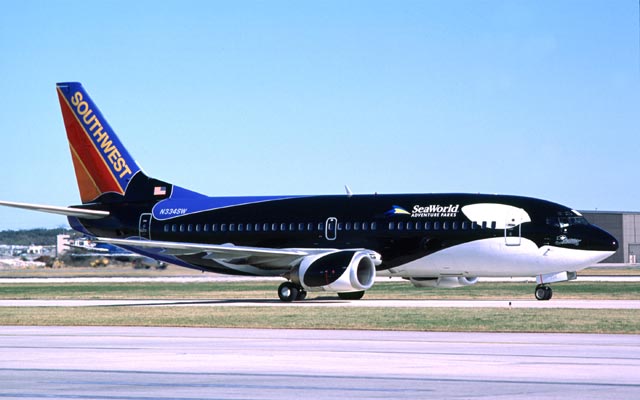 It's kinda cool. The inside is heavily decorated with SeaWorld advertising, too. Like all the overhead compartment doors are blue and watery looking, with either a SeaWorld logo or a picture of Shamu in action.
But this is the one I really want to fly on. I have no idea who sponsored it (or whether anyone did; they seem to have them for many states).
One of the things I appreciate about Southwest is their sense of whimsy. It's just more fun to fly with them (although I do miss the comical safety briefings they used to do...I assume the FAA decided it wasn't safe enough).
Wednesday, August 27, 2008
Tuesday, August 19, 2008
Oh, Dear...
There's a disconnect in here somewhere. My fortune cookie from lunch today reads
You would do well in the field of computer technology.Now they tell me....
Breaking Ties
The summer of 1968 was a most exciting and memorable one in my family. Not so much because of all the assassinations, protests, riots and such, but mostly because we got to see it all in color for the first time. You see, in the summer of 1968, my grandfather bought himself a new color television, and gave us his old one as a hand-me-down.
The TV itself was a marvel to me, for all sorts of reasons I entirely take for granted nowadays. Not only were the pictures in color, but it had a remote control that could change the channel, volume, color and tint. I'm unclear which was more exciting: the discovery of channel surfing or the ability to make all the faces pink or green while sitting across the room.
Wow. Just wow.
The coolest thing from a modern, digital perspective was the way the remote control worked. The TV still had dials and knobs for changing channels and such, and the remote activated servos that turned the physical controls on the TV, so channel surfing still had the satisfying "clunk" of the old TV, plus you got to watch the knobs and dials move when you pushed buttons on the remote. Endless fun, really.
Two things we watched that summer probably shaped a lot of my future life: political conventions and the Olympics. I know there was other stuff on, but those are the ones I still remember vividly.
I certainly didn't understand much of the conventions, but the color, the bunting, the balloons, the big signs, the roll call of states with each delegation chairman trying to outdo the next with lavish praise for his home state before eventually casting the votes, the cheers: all made huge impressions. The sheer spectacle of American democracy at work was thrilling. I was also quite oblivious to all the protests and riots going on outside the convention hall. It was just the color and pageantry, the ritual, the excitement. I was hooked.
I'm sure that all had a lot to do with my later involvement in politics and government. By 1972, I was volunteering at the local party headquarters, and the substance of the convention and the nominating process was of interest. But every four years I still get quite a charge out of the memory of my first glimpse of a political convention.
The Olympics from Mexico City were something else altogether. In many ways, I think they were the first sporting event I was ever aware of. Neither of my parents ever gave a damn about sports (although Dad eventually paid attention because I was a sports nut; kind of a weird reversal of the way that usually happens, I think). But every four years, there they were, glued to the set, watching and following and rooting.
As with the conventions, I think it was the spectacle of the Olympics that caught my interest. I don't remember any particular events, just all of this weird, unaccustomed stuff on the TV, and my parents sitting and watching it, making time in their lives for this big event. Again, by 1972 I was actually interested in sports and the content of the games. But in 1968, I was hooked.
All of this is a very long-winded introduction to the topic that prompted me to write today, which is the current foofaraw over scoring in Olympic gymnastics. It always sort of amuses me that the two most popular Olympic sports on U.S. television, gymnastics and ice skating, share (at least) two things in common: almost no one pays any attention to them outside of the Olympics, and all these fair-weather fans seem to have strong opinions about the arcane and subjective scoring systems that govern the sports.
As far as I can tell, the one constant in the Olympic universe is controversy over the scoring of those two sports. The recent fuss over the tie breaker in women's gymnastics is just the latest example. And everyone seems to have their own opinion as to what must be done.
I come at this from the perspective not of an athlete, but as a former competitor and coach/administrator in forensics (speech and debate). The issues are similar, if not as much fun to watch on television. From the competitor's standpoint, you need to know what the rules are, and you want to know that they are applied fairly. As an administrator, you sometimes need to be able to break a tie score, as you sometimes need to come up with a particular number of winners at some stage in the competition.
As my wife and I discussed this last night, we both recalled instances when we were competing and tie-breakers came into play. In both cases we remembered being eliminated from competitions on the basis of tie-breakers. And I certainly remember applying tie-breaking rules a number of times when I was running tournaments. It's never desirable, but sometimes necessary.
This brings to mind two points about the gymnastics controversy:
The TV itself was a marvel to me, for all sorts of reasons I entirely take for granted nowadays. Not only were the pictures in color, but it had a remote control that could change the channel, volume, color and tint. I'm unclear which was more exciting: the discovery of channel surfing or the ability to make all the faces pink or green while sitting across the room.
Wow. Just wow.
The coolest thing from a modern, digital perspective was the way the remote control worked. The TV still had dials and knobs for changing channels and such, and the remote activated servos that turned the physical controls on the TV, so channel surfing still had the satisfying "clunk" of the old TV, plus you got to watch the knobs and dials move when you pushed buttons on the remote. Endless fun, really.
Two things we watched that summer probably shaped a lot of my future life: political conventions and the Olympics. I know there was other stuff on, but those are the ones I still remember vividly.
I certainly didn't understand much of the conventions, but the color, the bunting, the balloons, the big signs, the roll call of states with each delegation chairman trying to outdo the next with lavish praise for his home state before eventually casting the votes, the cheers: all made huge impressions. The sheer spectacle of American democracy at work was thrilling. I was also quite oblivious to all the protests and riots going on outside the convention hall. It was just the color and pageantry, the ritual, the excitement. I was hooked.
I'm sure that all had a lot to do with my later involvement in politics and government. By 1972, I was volunteering at the local party headquarters, and the substance of the convention and the nominating process was of interest. But every four years I still get quite a charge out of the memory of my first glimpse of a political convention.
The Olympics from Mexico City were something else altogether. In many ways, I think they were the first sporting event I was ever aware of. Neither of my parents ever gave a damn about sports (although Dad eventually paid attention because I was a sports nut; kind of a weird reversal of the way that usually happens, I think). But every four years, there they were, glued to the set, watching and following and rooting.
As with the conventions, I think it was the spectacle of the Olympics that caught my interest. I don't remember any particular events, just all of this weird, unaccustomed stuff on the TV, and my parents sitting and watching it, making time in their lives for this big event. Again, by 1972 I was actually interested in sports and the content of the games. But in 1968, I was hooked.
All of this is a very long-winded introduction to the topic that prompted me to write today, which is the current foofaraw over scoring in Olympic gymnastics. It always sort of amuses me that the two most popular Olympic sports on U.S. television, gymnastics and ice skating, share (at least) two things in common: almost no one pays any attention to them outside of the Olympics, and all these fair-weather fans seem to have strong opinions about the arcane and subjective scoring systems that govern the sports.
As far as I can tell, the one constant in the Olympic universe is controversy over the scoring of those two sports. The recent fuss over the tie breaker in women's gymnastics is just the latest example. And everyone seems to have their own opinion as to what must be done.
I come at this from the perspective not of an athlete, but as a former competitor and coach/administrator in forensics (speech and debate). The issues are similar, if not as much fun to watch on television. From the competitor's standpoint, you need to know what the rules are, and you want to know that they are applied fairly. As an administrator, you sometimes need to be able to break a tie score, as you sometimes need to come up with a particular number of winners at some stage in the competition.
As my wife and I discussed this last night, we both recalled instances when we were competing and tie-breakers came into play. In both cases we remembered being eliminated from competitions on the basis of tie-breakers. And I certainly remember applying tie-breaking rules a number of times when I was running tournaments. It's never desirable, but sometimes necessary.
This brings to mind two points about the gymnastics controversy:
- As far as I can tell, the tie-breaking rules were followed fairly and appropriately. Most of the issues I heard discussed had to do with the quality of the judging that produced the weird tie, and a little about whether the tie-breaking formula was a good one. I heard no indication that the tie was improperly broken.
- Perhaps more importantly, it is entirely unclear to me why the tie needed to be broken (other than the fact that the rules said so). Other sports allow ties in the Olympics, and there seems to be no harm in awarding two gold medals in a particular apparatus. It's not as if a single winner needs to advance to another level of competition or something.
Subscribe to:
Posts (Atom)


