
Yesterday, our river rafting guide was pretty much putting on a show, spinning the raft, rocking it, steering us under waterfalls, and so on. I described him as one part river guide, two parts clown, which probably isn't too far off.
But the thing I just realized this morning is that I found it really irritating as he did all those things, not because he did them (they were fun!), but because always as he did them, he would laugh and say "Sorry, sorry my friends!" Now, he doesn't know us, and probably can't remember our names (just as I can't recall his), and it's all a part of the act. But that repeated phrase, "my friends," just rubbed me wrong.
And this morning I remembered why: it's a catch phrase of a certain U.S. Senator from Arizona who is running for president, and I am not, not, not looking forward to plunking back into the middle of a presidential election campaign when I get home. Ugh.
One thing I also realized is that after the ride, as we were walking back up from the river, we actually struck up a conversation with our guide, and despite his limited English, he didn't use the "my friends" tic except when giving his canned directions on where to go or sit, how to board the truck, etc. It's part of the act, and only part of the act.
I'm just guessing that John McCain doesn't address his actual friends as "my friends," either. Just a thought.
Saturday, September 27, 2008


Friday, September 26, 2008
Indonesian Elephants
[Note: this information is all based on things I've been told the last few days by people in Bali. I have not had Internet access to verify facts. Errors are probably due to my faulty memory or misunderstanding.]
Until this trip, I wasn't aware that there were elephants native to Indonesia. Over the last couple of days I've seen a lot of elephant artwork, which I originally assumed was just Hindu style borrowed from India. But it turns out that at least one of the big Indonesian islands, Sumatra, still has a native population of Asian elephants. Borneo may have, at one time, but does not currently.
It turns out that Sumatra has a problem with dwindling numbers of elephants. As in other areas, elephants are threatened by poachers looking for tusks and by habitat loss. The native population of elephants now on Sumatra is maybe 2,000. Note that this problem is not confined to elephants. Sumatra is also widely known for its tigers, rhinoceroses, and orangutans, all now critically endangered.
So the Indonesian elephants are all now owned (or at least controlled) by the government, which is running a conservation and breeding program. Because of the pressures on Sumatra, they have chosen to send some of the elephants to other islands, where sponsors such as the Bakas park take care of them. Bakas has ten, and three other parks on Bali have 19, 20, and 27. [Note: there might only be two others; that 19, 20 might have been two guesses at the same park...possible transcription error in my brain.] As far as anyone can tell, Bali never had a native population of elephants. Frankly, it's a pretty small island, so the absence of a huge herbivore is not a surprise. But it also means that the elephants are out of their native habitat, and so have trouble feeding themselves.
So the government assigns mahouts to the elephants, at least some of which are park rangers. These mahouts have to report to the government daily on the health, environment, and care the animals receive. The government can decide, literally at any time, to pull the loaner elephants back home to Sumatra.
This makes life interesting, to say the least, for the mahouts. Mo, the mahout we rode with today, decided in high school on Sumatra that he wanted to help save his country's elephants. And after extensive training, he was assigned to the newborn he named Febi. They have now been together for 14 years.
 Seven years ago, the government decided to send Febi to Bali, and Mo with him. Mo's family, all office workers, had never been keen on his career choice, and his girlfriend doesn't like Bali, so she is on Sumatra. The pay is better on Bali, though the cost of living is higher and he no longer lives with his family. On the other hand, there are also more tourists on Bali, so more tips. Even though Mo is fascinated by the world and would love to travel, he is pretty much tied to Febi, 24/7, so he takes comfort in the fact that his picture travels all over the world with tourists.
I asked Mo what language he speaks to Febi in, as none of his commands were intelligible to me. He said it's a combination of three languages: Thai (his original mahout teacher/trainer was Thai), English, and Indonesian. Then he smiled and added, "And my feet." Indeed, he seems to do nearly all of his steering by foot pressures on Febi's head, along with gentle hand touches and a few words.
Life for Febi seems pretty good. We got to watch the morning elephant wash, and both Mo and Febi seemed to enjoy it greatly. Having the same full-time mahout seems to be great for the elephants, but seems pretty hard on the trainers. Still, Mo clearly loves his work. He smiles almost constantly, and speaks with great affection both for Febi and for elephants in general.
Until this trip, I wasn't aware that there were elephants native to Indonesia. Over the last couple of days I've seen a lot of elephant artwork, which I originally assumed was just Hindu style borrowed from India. But it turns out that at least one of the big Indonesian islands, Sumatra, still has a native population of Asian elephants. Borneo may have, at one time, but does not currently.
It turns out that Sumatra has a problem with dwindling numbers of elephants. As in other areas, elephants are threatened by poachers looking for tusks and by habitat loss. The native population of elephants now on Sumatra is maybe 2,000. Note that this problem is not confined to elephants. Sumatra is also widely known for its tigers, rhinoceroses, and orangutans, all now critically endangered.
So the Indonesian elephants are all now owned (or at least controlled) by the government, which is running a conservation and breeding program. Because of the pressures on Sumatra, they have chosen to send some of the elephants to other islands, where sponsors such as the Bakas park take care of them. Bakas has ten, and three other parks on Bali have 19, 20, and 27. [Note: there might only be two others; that 19, 20 might have been two guesses at the same park...possible transcription error in my brain.] As far as anyone can tell, Bali never had a native population of elephants. Frankly, it's a pretty small island, so the absence of a huge herbivore is not a surprise. But it also means that the elephants are out of their native habitat, and so have trouble feeding themselves.
So the government assigns mahouts to the elephants, at least some of which are park rangers. These mahouts have to report to the government daily on the health, environment, and care the animals receive. The government can decide, literally at any time, to pull the loaner elephants back home to Sumatra.
This makes life interesting, to say the least, for the mahouts. Mo, the mahout we rode with today, decided in high school on Sumatra that he wanted to help save his country's elephants. And after extensive training, he was assigned to the newborn he named Febi. They have now been together for 14 years.
 Seven years ago, the government decided to send Febi to Bali, and Mo with him. Mo's family, all office workers, had never been keen on his career choice, and his girlfriend doesn't like Bali, so she is on Sumatra. The pay is better on Bali, though the cost of living is higher and he no longer lives with his family. On the other hand, there are also more tourists on Bali, so more tips. Even though Mo is fascinated by the world and would love to travel, he is pretty much tied to Febi, 24/7, so he takes comfort in the fact that his picture travels all over the world with tourists.
I asked Mo what language he speaks to Febi in, as none of his commands were intelligible to me. He said it's a combination of three languages: Thai (his original mahout teacher/trainer was Thai), English, and Indonesian. Then he smiled and added, "And my feet." Indeed, he seems to do nearly all of his steering by foot pressures on Febi's head, along with gentle hand touches and a few words.
Life for Febi seems pretty good. We got to watch the morning elephant wash, and both Mo and Febi seemed to enjoy it greatly. Having the same full-time mahout seems to be great for the elephants, but seems pretty hard on the trainers. Still, Mo clearly loves his work. He smiles almost constantly, and speaks with great affection both for Febi and for elephants in general.
Just Singing and Dancing in the Rain
The rain didn't really let up until after the dance show. The show itself was moved from the Ubud Palace to the public hall across the street (under a roof) because of the rain. The show itself is very impressive. The skill and precision of the musicians and dancers is amazing. I have to admit I kind of lost the thread of the story, but followed the long-ago advice of a wise friend: "It's art, Chard. Just let it flow over you."
So I did, and it was good. We were there pretty early, so had seats in the second row to one side. Good spot to watch the gamelan players and the drummers, and prime position to watch the monkey (a dancer; not a real monkey this time). This photo set on Flickr seems to be the same show, two weeks earlier.
After the show, we lit out for one of the restaurants that had been recommended by the ex-pats on the dive boat who live in Bali. Lamak had, as promised, excellent cocktails and dinners. Both the pancetta-wrapped mahi-mahi and the scallops were most tasty.
By the time we got to dinner, I was pretty dry again. I had chivalrously given the umbrella to my lovely wife, and I got pretty soaked as a result. And all's well that ends in a tasty dinner.
Oh, and one more new experience to add to my list: when we had the restaurant call the hotel to give us a ride back, they sent over two motorbikes, so we rode back on the backs of them. My first ride on a motorbike, anywhere. I survived with only a small burn on my leg where it brushed the tailpipe.
So I did, and it was good. We were there pretty early, so had seats in the second row to one side. Good spot to watch the gamelan players and the drummers, and prime position to watch the monkey (a dancer; not a real monkey this time). This photo set on Flickr seems to be the same show, two weeks earlier.
After the show, we lit out for one of the restaurants that had been recommended by the ex-pats on the dive boat who live in Bali. Lamak had, as promised, excellent cocktails and dinners. Both the pancetta-wrapped mahi-mahi and the scallops were most tasty.
By the time we got to dinner, I was pretty dry again. I had chivalrously given the umbrella to my lovely wife, and I got pretty soaked as a result. And all's well that ends in a tasty dinner.
Oh, and one more new experience to add to my list: when we had the restaurant call the hotel to give us a ride back, they sent over two motorbikes, so we rode back on the backs of them. My first ride on a motorbike, anywhere. I survived with only a small burn on my leg where it brushed the tailpipe.
Tourist Season
Today has been one of those lessons in how tourists see the world. Yesterday's driver, Dewa, arranged for us to go river rafting and elephant riding today. A driver from the park picked us up at the hotel at 8 am, as planned, and promised us that the rain was done for the day (though it proceeded to rain essentially the entire way to the park).
In his limited English, he tried to sell us on the notion that we needed to stop in at a wood carving place on the way, and we tried to explain that we'd done that yesterday, but with limited success. He also wanted to get us to buy into the notion of hiring him tomorrow to take us up into the mountains and such (which Dewa is already going to do). Ah,well.
We have long-since clued in to the fact that wherever we go as tourists, cab drivers and such are always looking for ways to get you to particular stores, generally owned and run by their friends and family members, and from which they earn "commissions." Fortunately Dewa comes recommended by trusted friends who have traveled with him and even bought goods from his store that they are very pleased with. So there is a level of trust there. But still, there are some obligatory visits. And that's OK, as long as you understand what's happening.
But we got to the park, the Bakas Levi Rafting and Elephant Adventure, and paid our fee. First up was the elephants, which was good for us, because early in the morning is both cooler for us as passengers, but it also means the elephants and their mahouts are fresher. We watched as our elephant came out and had his morning bath, then got saddled up (in the form of a teak chair on blankets, tied on with ropes). Then we climbed aboard, and off for a one-hour ride through the surrounding area.
 Our elephant's name was Febi (pronounced like the English name "Phoebe"). We looked a little surprised, and Mo the mahout laughed a little sheepishly that he knows it's a female name. He named it after his sister, who dislikes elephants! Mo has been raising and training Febi (the elephant) since Febi was one day old, and has been with him almost nonstop for the ensuing 14 years. I'll write a separate entry later about some of the things we learned about elephants and their training in Indonesia. But for now, suffice it to say we had a pleasant and wide-ranging discussion with Mo as we rode.
Along the route we got to see a bunch of wild macaques, much like the ones we saw yesterday in the Monkey Forest, but without all the tourists and bananas. Febi foraged for snacks pretty much the whole way, as elephants will. We also saw domesticated pigs (quite unlike the wild pigs we've seen elsewhere), chickens with broods of chicks, and a number of birds.
At the end of ride came a couple of obligatory tricks, including balancing with all four feet on a small pedestal and sitting down on another (all with us still riding up top!). After a final chat and posing for portraits with Febi, we were off to river rafting.
There's not a lot to say about the rafting itself. The river doesn't run very fast, and it doesn't have a lot of drops, either. It was really more of a leisurely float, and we rarely had to paddle at all. We were the only two guests in the raft, along with the guide. Normally there would be 4-5 guests, but not this time. The guide (whose name escapes me, darn it!) did his best to make the tame ride more exciting, with lots of whooping and yelping and jokes, as well as turning the raft around and guiding us under waterfalls so we got good and wet.
 What the ride does have going for it is gorgeous scenery. The river runs through a rather steep canyon cut in volcanic rock, and the canyon itself is quite beautiful. And you also get nice views of the surrounding jungle, from a different, lower angle than we'd had from the elephant. All in all, it was a very pleasant ride.
Then, off for a quick shower and change of clothes, then a mediocre buffet lunch, then back with our driver, who again wanted to take us to wood carving or book us for tomorrow. Luckily, we were exhausted, and the tape he put on of bad covers of American music really put us to the snooze.
Back to the hotel, then, and my wife is now off getting a massage at the spa while I write. I'm going to go pick her up soon, and probably go see some Balinese dance at the palace.
Although I should note that it is raining. A lot. Again.
In his limited English, he tried to sell us on the notion that we needed to stop in at a wood carving place on the way, and we tried to explain that we'd done that yesterday, but with limited success. He also wanted to get us to buy into the notion of hiring him tomorrow to take us up into the mountains and such (which Dewa is already going to do). Ah,well.
We have long-since clued in to the fact that wherever we go as tourists, cab drivers and such are always looking for ways to get you to particular stores, generally owned and run by their friends and family members, and from which they earn "commissions." Fortunately Dewa comes recommended by trusted friends who have traveled with him and even bought goods from his store that they are very pleased with. So there is a level of trust there. But still, there are some obligatory visits. And that's OK, as long as you understand what's happening.
But we got to the park, the Bakas Levi Rafting and Elephant Adventure, and paid our fee. First up was the elephants, which was good for us, because early in the morning is both cooler for us as passengers, but it also means the elephants and their mahouts are fresher. We watched as our elephant came out and had his morning bath, then got saddled up (in the form of a teak chair on blankets, tied on with ropes). Then we climbed aboard, and off for a one-hour ride through the surrounding area.
 Our elephant's name was Febi (pronounced like the English name "Phoebe"). We looked a little surprised, and Mo the mahout laughed a little sheepishly that he knows it's a female name. He named it after his sister, who dislikes elephants! Mo has been raising and training Febi (the elephant) since Febi was one day old, and has been with him almost nonstop for the ensuing 14 years. I'll write a separate entry later about some of the things we learned about elephants and their training in Indonesia. But for now, suffice it to say we had a pleasant and wide-ranging discussion with Mo as we rode.
Along the route we got to see a bunch of wild macaques, much like the ones we saw yesterday in the Monkey Forest, but without all the tourists and bananas. Febi foraged for snacks pretty much the whole way, as elephants will. We also saw domesticated pigs (quite unlike the wild pigs we've seen elsewhere), chickens with broods of chicks, and a number of birds.
At the end of ride came a couple of obligatory tricks, including balancing with all four feet on a small pedestal and sitting down on another (all with us still riding up top!). After a final chat and posing for portraits with Febi, we were off to river rafting.
There's not a lot to say about the rafting itself. The river doesn't run very fast, and it doesn't have a lot of drops, either. It was really more of a leisurely float, and we rarely had to paddle at all. We were the only two guests in the raft, along with the guide. Normally there would be 4-5 guests, but not this time. The guide (whose name escapes me, darn it!) did his best to make the tame ride more exciting, with lots of whooping and yelping and jokes, as well as turning the raft around and guiding us under waterfalls so we got good and wet.
 What the ride does have going for it is gorgeous scenery. The river runs through a rather steep canyon cut in volcanic rock, and the canyon itself is quite beautiful. And you also get nice views of the surrounding jungle, from a different, lower angle than we'd had from the elephant. All in all, it was a very pleasant ride.
Then, off for a quick shower and change of clothes, then a mediocre buffet lunch, then back with our driver, who again wanted to take us to wood carving or book us for tomorrow. Luckily, we were exhausted, and the tape he put on of bad covers of American music really put us to the snooze.
Back to the hotel, then, and my wife is now off getting a massage at the spa while I write. I'm going to go pick her up soon, and probably go see some Balinese dance at the palace.
Although I should note that it is raining. A lot. Again.
Dry Season
We've had terrific weather during our stay in Indonesia. On the dive boat we were blessed with sunshine and soft breezes, which made for pleasant times both during and between dives. This is, of course, the dry season. In the rainy season it can be stormy and rather less pleasant on the boat.
Last night we noted as we got back to our hotel before dinner that the air was a bit misty. We saw clouds as we walked off to dinner, but we could also see stars. No worries.
During dinner, in rained. Only briefly, maybe 5-10 minutes, but it was pretty intense. Although the restaurant (like many, many buildings in Bali) is essentially outdoors but covered, we were happy and dry, sitting on our cushions, enjoying our meal, watching the rain fall. When we walked home after, the ground was wet, but it wasn't raining.
Overnight, though, it rained. A lot. The sound woke me several times in the night. This morning we both mentioned we were reminded of the opening line of one of my favorite stories from Winnie the Pooh: "It rained and it rained and it rained." This morning it is still raining a bit, off and on. We wonder whether the river rafting and elephant riding will take place. And we wonder, does it often rain this much in dry season?
Last night we noted as we got back to our hotel before dinner that the air was a bit misty. We saw clouds as we walked off to dinner, but we could also see stars. No worries.
During dinner, in rained. Only briefly, maybe 5-10 minutes, but it was pretty intense. Although the restaurant (like many, many buildings in Bali) is essentially outdoors but covered, we were happy and dry, sitting on our cushions, enjoying our meal, watching the rain fall. When we walked home after, the ground was wet, but it wasn't raining.
Overnight, though, it rained. A lot. The sound woke me several times in the night. This morning we both mentioned we were reminded of the opening line of one of my favorite stories from Winnie the Pooh: "It rained and it rained and it rained." This morning it is still raining a bit, off and on. We wonder whether the river rafting and elephant riding will take place. And we wonder, does it often rain this much in dry season?
Thursday, September 25, 2008
Beginning Bali
Diving being done, and thoughts of early home going having been dashed, we embarked with our hired driver/guide Dewa to see some of Bali and eventually end up at our hotel.
Leaving the airport at Denpasar, he first took us through the tourist district of Kuta. This was where the famous terrorist nightclub bombing took place back in 2002 (one year, one month, and one day after 9/11). We saw the memorial erected at the site, but didn't stop to spend time there. Our main reaction to Kuta was that we were really glad we had elected to stay elsewhere. Didn't really need the chain stores and nightclubs that could be in any tourist beach town in the world.
But we had expected this. Our friend Sharon had recommended not only that we hire Dewa, but that we spend our few days in something more like the real Bali, so we're in Ubud, about 45 minutes north of the tourists. The streets are narrower, the shops are smaller and have local flavor instead of designer labels. And it's really rather quiet.
On the drive up, we stopped at several places, including both stone and wood carving places and a small, local temple. Bali is known for both its carving crafts and its batik cloth, as well as its Hindu temples and dancing. The carvings are just amazing, even though we know they're produced in quantity for the tourist market. It is really high-quality stuff.
The temple was interesting. It's quite old, and constantly being renovated. But it has the sincere feel of a local church. Much less pretense than temples we visited in Fiji, for example.
We stopped for lunch at a local restaurant. Their pizza oven is in the stomach of a large carved stone turtle (wish I’d gotten a picture!). The dining room is on the top floor, open on all sides so you can see the surrounding country, which is largely rice fields. It was very calm and peaceful, and the food authentic and tasty (we skipped the pizza and had curry and fried noodles with veggies).
Then we stopped to check into our hotel, the Tunjung Mas Bungalows. It's a small place (6 bungalows, I believe), but quiet and lovely, easy walking distance to town. The name translates as "Golden Lotus Flower," and there are lots of lovely flowers on the grounds.
We then visited the Monkey Forest, where there are, unsurprisingly, about 300 macaque monkeys in residence. They're a hoot, running all about doing monkey business and delighting the tourists. Interestingly, there is a Hindu cemetery in the middle of the forest on a hill, and there was a community burial going on which we watched some of. I was not aware that in Bali, at least, they bury their dead for a while, then eventually exhume them for a mass cremation. The purpose is to save the expense of individual funerals.
After visiting Dewa's shop and his wife's, too, we crashed at the hotel for a bit before heading off to dinner at Bebek Bengil, which translates to the Dirty Duck Diner. It's a lovely setting, built on what used to be rice fields. It's extensive, but doesn't feel big or crowded, as the facilities are really well designed. There is flowing water and fountains throughout, and tables that feel private. The food was quite tasty, and we both tried cocktails made with arak, the local liquor. Rather a strong flavor, so we switched to Bintang, the local pilsner beer.
Whew! Long, busy day, and we have to get up in the morning to go river rafting and elephant riding before Jan's spa appointment and Balinese dancing at the old palace. Hey, short visit, no time to waste!
Leaving the airport at Denpasar, he first took us through the tourist district of Kuta. This was where the famous terrorist nightclub bombing took place back in 2002 (one year, one month, and one day after 9/11). We saw the memorial erected at the site, but didn't stop to spend time there. Our main reaction to Kuta was that we were really glad we had elected to stay elsewhere. Didn't really need the chain stores and nightclubs that could be in any tourist beach town in the world.
But we had expected this. Our friend Sharon had recommended not only that we hire Dewa, but that we spend our few days in something more like the real Bali, so we're in Ubud, about 45 minutes north of the tourists. The streets are narrower, the shops are smaller and have local flavor instead of designer labels. And it's really rather quiet.
On the drive up, we stopped at several places, including both stone and wood carving places and a small, local temple. Bali is known for both its carving crafts and its batik cloth, as well as its Hindu temples and dancing. The carvings are just amazing, even though we know they're produced in quantity for the tourist market. It is really high-quality stuff.
The temple was interesting. It's quite old, and constantly being renovated. But it has the sincere feel of a local church. Much less pretense than temples we visited in Fiji, for example.
We stopped for lunch at a local restaurant. Their pizza oven is in the stomach of a large carved stone turtle (wish I’d gotten a picture!). The dining room is on the top floor, open on all sides so you can see the surrounding country, which is largely rice fields. It was very calm and peaceful, and the food authentic and tasty (we skipped the pizza and had curry and fried noodles with veggies).
Then we stopped to check into our hotel, the Tunjung Mas Bungalows. It's a small place (6 bungalows, I believe), but quiet and lovely, easy walking distance to town. The name translates as "Golden Lotus Flower," and there are lots of lovely flowers on the grounds.
We then visited the Monkey Forest, where there are, unsurprisingly, about 300 macaque monkeys in residence. They're a hoot, running all about doing monkey business and delighting the tourists. Interestingly, there is a Hindu cemetery in the middle of the forest on a hill, and there was a community burial going on which we watched some of. I was not aware that in Bali, at least, they bury their dead for a while, then eventually exhume them for a mass cremation. The purpose is to save the expense of individual funerals.
After visiting Dewa's shop and his wife's, too, we crashed at the hotel for a bit before heading off to dinner at Bebek Bengil, which translates to the Dirty Duck Diner. It's a lovely setting, built on what used to be rice fields. It's extensive, but doesn't feel big or crowded, as the facilities are really well designed. There is flowing water and fountains throughout, and tables that feel private. The food was quite tasty, and we both tried cocktails made with arak, the local liquor. Rather a strong flavor, so we switched to Bintang, the local pilsner beer.
Whew! Long, busy day, and we have to get up in the morning to go river rafting and elephant riding before Jan's spa appointment and Balinese dancing at the old palace. Hey, short visit, no time to waste!
Last Seven Seas Thoughts
Just wanted to put down a few more thoughts about the recently-competed diving aboard the Seven Seas before I start scribbling about Bali.
First, I have to say that the Seven Seas was a very nice, very well-run operation. Mark and his crew did an excellent job of making us all feel welcome, comfortable, and safe. The boat itself is lovely, and the dive crew and kitchen crew were all top-notch. Good food (self-serve is nice), friendly service, and all well maintained. I believe we had one of the smallest cabins on the boat, but it was quite adequate. We stored our luggage and some other things on the unused upper bunk. Getting dressed with two of us was challenging at times, but we managed.
And the diving was really, really good. Graham made sure we got a taste of all the different environments available around Komodo, and Tomi and Bram and the boat drivers made sure we saw the key things and got to and from the sites quickly and easily. Best of all, I felt like Mark and his crew had a good, positive working relationship. I didn't sense any of the labor-management tensions that often creep into dive-boat operations.
It was hard to say goodbye, but after ten days and about 35 dives, we were ready to think about heading home.
We'd had some thoughts about trying to get home sooner, rather than spending an extra four days in Bali, but Continental Airlines assured us that the one flight leaving before ours on Sunday, tonight, was already overbooked considerably. So we headed off for a little mini-adventure in Bali.
First, I have to say that the Seven Seas was a very nice, very well-run operation. Mark and his crew did an excellent job of making us all feel welcome, comfortable, and safe. The boat itself is lovely, and the dive crew and kitchen crew were all top-notch. Good food (self-serve is nice), friendly service, and all well maintained. I believe we had one of the smallest cabins on the boat, but it was quite adequate. We stored our luggage and some other things on the unused upper bunk. Getting dressed with two of us was challenging at times, but we managed.
And the diving was really, really good. Graham made sure we got a taste of all the different environments available around Komodo, and Tomi and Bram and the boat drivers made sure we saw the key things and got to and from the sites quickly and easily. Best of all, I felt like Mark and his crew had a good, positive working relationship. I didn't sense any of the labor-management tensions that often creep into dive-boat operations.
It was hard to say goodbye, but after ten days and about 35 dives, we were ready to think about heading home.
We'd had some thoughts about trying to get home sooner, rather than spending an extra four days in Bali, but Continental Airlines assured us that the one flight leaving before ours on Sunday, tonight, was already overbooked considerably. So we headed off for a little mini-adventure in Bali.
Wednesday, September 24, 2008
Boats to Build
 We did a really interesting little tour of a village known for building boats. Unfortunately, I seem to have neglected to write down the name of the village, so I hope one of my trip mates can fill in that gap.
 Anyway, they build boats in the traditional Indonesian way, which is to say, by hand, from wood. They use a few metal bolts in key locations, but for the most part, it’s wooden pegs, driven by wooden hammers. They do use an electric drill, however.
 Some of the fascinating aspects of the process are that, unlike Western ship-building, they build the hull's planking first, then individually shape the ribs to fit the planks. By hand. And nearly everything about the process is handmade of wood, like the ladders down into the boat, the roof over the hull that shelters the workers (and the boat) from sun and rain. I hope my pictures can convey some of that.
 We climbed up a ramp to look into one of the hulls that was in process. It’s not nearly as rickety as it appears, though it is a bit steep, with not much in the way of a railing. Depending on who you ask, the four guys building this boat have been at work on it for either one or two years so far. There’s still much to do, including plugging the gaps between the planks and adding decking. Once the hull is complete, they have to launch the boat and tow it to another island where it gets its engine and other finishing.
The village itself was pretty interesting. We stopped by one house and saw people weaving. We walked through much of the town, followed by a horde of children. One teenage boy was talking to his girlfriend on his mobile phone so she could hear us speaking English. Several people in our group had brought gifts for the children of the village, including pencils and books. I thought a riot was going to break out over the package of pencils. It’s hard to believe how much of a difference such a thing can make in a kid’s life, but we later had one little girl showing off her pencil and just beaming.
We saw lots of motorbikes in town, but only a few cars. The biggest, fanciest house belongs to one of the big boat-builders, naturally. That is really the business of the village. But we saw other interesting stuff, like a shack with a hand-painted sign that reads "Rental Playstation." For a place with little apparent electricity, that seemed odd.
Poking About
Diving (and the visit to Komodo National Park) is winding down. Josh is editing his trip video, which promises to be splendid, as always. This morning we visited an interesting site where a big boulder from the top of the reef recently (like 12-18 months ago) rolled down to about 90 feet. In the wake of its roll, there are a lot of small rocks in the black sand. And among them, more nudibranchs than I can describe. Graham says it's the premier nudibranch dive in all Asia.
It's funny how we can get from watching schools of big fish one dive to poking under rocks for tiny slugs the next. Truly, I enjoy both. One of the joys of looking so closely at small things is that you notice more and more detail the longer you look. You might start out looking for a pretty nudibranch and notice a tiny shrimp or a well-hidden crab. Much like life in general, I suppose: When you're open to seeing things, you might see things you didn't expect.
Volcano update: The cone was shrouded in clouds this morning. Unfortunately I didn't get to take a picture, so you'll have to take my word for it.
It's funny how we can get from watching schools of big fish one dive to poking under rocks for tiny slugs the next. Truly, I enjoy both. One of the joys of looking so closely at small things is that you notice more and more detail the longer you look. You might start out looking for a pretty nudibranch and notice a tiny shrimp or a well-hidden crab. Much like life in general, I suppose: When you're open to seeing things, you might see things you didn't expect.
Volcano update: The cone was shrouded in clouds this morning. Unfortunately I didn't get to take a picture, so you'll have to take my word for it.
Tuesday, September 23, 2008
I Don't Know
Good diving today. We're still at Sangeang Island, and this morning conditions were very mild, so we got to dive again at Deep Purple and Bubble Reef in the morning with essentially no current. Then an afternoon dive at Sangeang Rocks, where we bimbled (Graham's term for it) around the rocks looking for critters. I found lots of little shrimps and crabs, some little nudibranchs, and a few little fish. Lots of baby and juvenile fish on all the dives; this is a great time of year for that.
 As we rode the skiff back to the boat, we noticed the smell of smoke in the air, and someone pointed out that the top of the volcano is smoking a bit. Last night coming back from the night dive we had noticed an orange glow up there, too. No notion that things might blow, but it's kind of fun being next to an active volcano.
UPDATE: As the sun went down, we could see the orange glow up near the top of the volcano. There was some debate over whether we were seeing lava or a fire, but Graham assures us there is nothing up there that would burn (anymore), so we concluded that it was lava glowing. Kind of eerie and yet cool.
 As we rode the skiff back to the boat, we noticed the smell of smoke in the air, and someone pointed out that the top of the volcano is smoking a bit. Last night coming back from the night dive we had noticed an orange glow up there, too. No notion that things might blow, but it's kind of fun being next to an active volcano.
UPDATE: As the sun went down, we could see the orange glow up near the top of the volcano. There was some debate over whether we were seeing lava or a fire, but Graham assures us there is nothing up there that would burn (anymore), so we concluded that it was lava glowing. Kind of eerie and yet cool.
Monday, September 22, 2008
Small and Large
Fascinating deep dive this morning at Sangeang Island, a relatively-recently active volcano with lots of black sand. We dropped down about 110 feet into a canyon full of fan corals and such. I found a huge scallop on the wall, probably the largest I've ever seen. Working with our friend Sharon, I also spotted a tiny pygmy seahorse on one of the fan corals.
Probably the oddest find was a dive mask one of our friends found sitting on top of the reef. The cover on the mask strap had the logo of our local dive shop back home, Bamboo Reef! We decided to leave it there. I'm hoping someone can snap a picture of it when we go back later this morning.
Probably the oddest find was a dive mask one of our friends found sitting on top of the reef. The cover on the mask strap had the logo of our local dive shop back home, Bamboo Reef! We decided to leave it there. I'm hoping someone can snap a picture of it when we go back later this morning.
Sunday, September 21, 2008
Life on the Reef
Today we're at Banta Island, not technically part of Komodo National Park, but just outside. The water is warmer again, and the dive site we're currently visiting, called K2, is quite spectacular. The late morning dive was particularly good, with lots of light, warm water, and just about the whole range of reef life on display. As we swam along, we could feel different currents blending, which is usually a signal that much will be happening. The different currents bring in nutrients, and that was certainly in evidence.
Many corals that are usually only open at night were fully out and feeding. Schools of reef fish that are normally lurking in or near their coral homes were out in the open, gorging themselves on yummy planktonic lunches. From the perspective of our photographer friends, the visibility isn't all they'd like, but the amount of life on display more than makes up for it.
At one point I spotted a couple of groupers, so I watched, thinking I might get a repeat or a variation on yesterday's courtship dance. Instead, one took off almost immediately, headed down the reef. As I pointed out the remaining one to my buddy, he spooked a little, and moved away. Almost instantly, the “rock” above him moved, revealing itself to be a fairly good sized, very well camouflaged, octopus!
I tried to get the octopus to play, but it only wanted me to go away. Doug came and got a few pictures, but by the time Andrew and his video camera got there, the octopus wanted nothing more than to hide. He found a rather deep hole in the reef, where I could barely see a tentacle and an eye, so I figured we were done.
Many corals that are usually only open at night were fully out and feeding. Schools of reef fish that are normally lurking in or near their coral homes were out in the open, gorging themselves on yummy planktonic lunches. From the perspective of our photographer friends, the visibility isn't all they'd like, but the amount of life on display more than makes up for it.
At one point I spotted a couple of groupers, so I watched, thinking I might get a repeat or a variation on yesterday's courtship dance. Instead, one took off almost immediately, headed down the reef. As I pointed out the remaining one to my buddy, he spooked a little, and moved away. Almost instantly, the “rock” above him moved, revealing itself to be a fairly good sized, very well camouflaged, octopus!
I tried to get the octopus to play, but it only wanted me to go away. Doug came and got a few pictures, but by the time Andrew and his video camera got there, the octopus wanted nothing more than to hide. He found a rather deep hole in the reef, where I could barely see a tentacle and an eye, so I figured we were done.
Saturday, September 20, 2008
Love is in the Water
We're south of the equator here (8 degrees or so), which means that it's Spring, and you can certainly tell by the behavior of the critters hereabouts.
We did two dives today at a site called Castle Rock, where there is often a current running ("breezy" or "drafty" and sometimes "gusty," depending on who you listen to). Currents tend to bring in bigger life, and this site is no exception. As we dropped in, we could see numerous white tip reef sharks cruising by. There we lots of trevally jacks, mackerel, and some tuna, too. Some of the mackerel were getting a bit frisky, swimming side-by-side, bumping into each other, getting excited.
After watching that show for a while, we headed up the sea mount to shallower water. There were some really nice corals and lots of fish; pleasant to watch. I spotted a pair of camouflage groupers circling around one another. This was clearly a mating/courting ritual. We watched for a while, and then noticed a much bigger grouper come peeking around the rock, apparently deciding all was going well, and heading off again. I decided this must be the chaperon. After a couple more minutes a third grouper of the same sort, but showing rather different coloration, joined in. One of the others, presumably the female, moved off, and the two others literally faced off, sitting nose-to-nose for a couple of minutes. Then there was a little snapping, some displays of wide-open mouths, and the interloper (I think) moved on. The female returned, and the courting resumed.
One positive thing I noticed this morning was a crown-of-thorns starfish. These are known as a great, voracious pest in many places, and the last time I recall seeing any was on our honeymoon ten years ago in Fiji, where they had devastated quite a number of reefs, practically scraping them bare. We were told at the time that the rise of the crown-of-thorns correlated with the decline of giant clams, which filter enormous amounts of water, including filtering out the eggs of the crown-of-thorns.
Here we have noted quite a few clams, although not the truly huge ones, but they seem to be doing the job of keeping the crown-of-thorns in check. Balance is important.
We did two dives today at a site called Castle Rock, where there is often a current running ("breezy" or "drafty" and sometimes "gusty," depending on who you listen to). Currents tend to bring in bigger life, and this site is no exception. As we dropped in, we could see numerous white tip reef sharks cruising by. There we lots of trevally jacks, mackerel, and some tuna, too. Some of the mackerel were getting a bit frisky, swimming side-by-side, bumping into each other, getting excited.
After watching that show for a while, we headed up the sea mount to shallower water. There were some really nice corals and lots of fish; pleasant to watch. I spotted a pair of camouflage groupers circling around one another. This was clearly a mating/courting ritual. We watched for a while, and then noticed a much bigger grouper come peeking around the rock, apparently deciding all was going well, and heading off again. I decided this must be the chaperon. After a couple more minutes a third grouper of the same sort, but showing rather different coloration, joined in. One of the others, presumably the female, moved off, and the two others literally faced off, sitting nose-to-nose for a couple of minutes. Then there was a little snapping, some displays of wide-open mouths, and the interloper (I think) moved on. The female returned, and the courting resumed.
One positive thing I noticed this morning was a crown-of-thorns starfish. These are known as a great, voracious pest in many places, and the last time I recall seeing any was on our honeymoon ten years ago in Fiji, where they had devastated quite a number of reefs, practically scraping them bare. We were told at the time that the rise of the crown-of-thorns correlated with the decline of giant clams, which filter enormous amounts of water, including filtering out the eggs of the crown-of-thorns.
Here we have noted quite a few clams, although not the truly huge ones, but they seem to be doing the job of keeping the crown-of-thorns in check. Balance is important.
Friday, September 19, 2008
Big Black Fish
A highlight of the afternoon was a dive along a reef that culminated in us "hooking on" to the reef in a strong current while "big, black fish" came to check us out. I'm not entirely clear why the dive guide didn't want to say what kind of big, black fish we might bee seeing. I guess either he didn't want to jinx us, or he wanted the nature of the fish to be a surprise.
In any case, after swimming along the reef for a bit, we swooped up through a gully into shallow water and grabbed onto pieces of dead coral rock. As the current rushed by, we scanned for big, black fish.
And then, they came: Manta rays. At least four of them, about 5-6 feet across. They would swim up through our streams of bubbles, almost close enough that we could touch them. Then they'd open up their mouths and float back on the current, feeding as they went. It was great, and went on, over and over, for about half an hour. We had a blast.
Later, some folks went back to snorkel at the same site. They had some good encounters, but only when there were also divers in the waters. They appear to really like the bubbles. When the divers were gone, the mantas still played and fed in the current, but farther away from the people.
In any case, after swimming along the reef for a bit, we swooped up through a gully into shallow water and grabbed onto pieces of dead coral rock. As the current rushed by, we scanned for big, black fish.
And then, they came: Manta rays. At least four of them, about 5-6 feet across. They would swim up through our streams of bubbles, almost close enough that we could touch them. Then they'd open up their mouths and float back on the current, feeding as they went. It was great, and went on, over and over, for about half an hour. We had a blast.
Later, some folks went back to snorkel at the same site. They had some good encounters, but only when there were also divers in the waters. They appear to really like the bubbles. When the divers were gone, the mantas still played and fed in the current, but farther away from the people.
Here Be Dragons
 This morning we awoke at Komodo Island. After breakfast we took the skiffs over to the visitor center at the park, where we hired guides to walk us around the island. On the walk we saw a lot of deer, a couple of wild pigs, Imperial pigeons, chickens, eagles, and some other birds. But no dragons. We did see some genuine dragon poo, complete with deer hair, so we know they are around and feeding.
As luck would have it, however, there are four big dragons who like to hang out by the kitchen at the ranger station, so they took us over there. It's not the same as seeing them truly in the wild, but they are wild and uncaged. Lovely animals, if a bit slothful this morning.
The island itself, at least the part we hiked, is quite dry ('tis the season)and not particularly diverse. After the obligatory stop at the ranger-station souvenir shop and one other little higher-end gift shop (I so wanted to buy a plush Komodo dragon, but didn't want to carry it home!) we walked through a local market where we were offered carved dragons (many wearing scuba gear), pearls, and some other crafts. Little kids followed us back to the skiff, imploring us to buy some pearls, a necklace, a carving. Or give us your hat, your sunglasses, something. They ultimately seemed pretty pleased with our plastic water bottles.
One of the ongoing difficulties in diving in some of these remote, impoverished areas is how to deal with such requests. We have so much, it seems criminal to leave without leaving something behind. Most of us try to help, and often bring some small gifts for the villagers, but it is always difficult.
I guess I'm slightly disappointed in the dragon encounter. It's cool to have seen them. In some ways the distant spotting of them on the beach the other morning was more satisfying, but both reinforce that we are really in Komodo.
Now back to diving for a bit. Supposed to be lots of fish life hereabouts.
Thursday, September 18, 2008
Good Days and Bad Days

We've spent two days moored in Horseshoe Cove at the southern end of Rinca Island. There are several terrific dive sites within short skiff rides, so the boat stays put, and we get to choose from many options.
The beach right in front of the boat occasionally features a little wildlife. Wild pigs come out to forage (a family of four, at least). We've seen a deer rearing up to eat leaves off a mangrove tree. And...dragons. At least two small Komodo dragons have put in appearances. All too far away for my little camera to register them, but through binoculars they're quite clear.
One afternoon we took a bowl of fish and chicken parts over to the beach to see whether we could entice any dragons to come into camera range. One did poke his nose out onto the beach while we were way down at the other end, but by the time we got back to his area, he was long gone.
While we strolled the beach waiting for dragons, I took the opportunity to shoot some pictures of the trash washed up along the tide line. Ugh. Much as we'd seen in Sian Ka'an preserve in the Yucatan, there was a load of mostly plastic trash all around the high tide line. Rumor has it that cruise ships dump their trash not far off shore. We found lots of food packets, bottles, bottle caps, and just small bits of brightly colored plastic.
Very sad, here in a national park, a World Heritage Site, to find more signs of negligent human activity.
Monday, September 15, 2008
Let the Diving Begin!

Just finished our first dive off the Seven Seas. We're anchored off Wainilu Point on Rinca Island, next door neighbor to Komodo Island. This spot is terrific for critter diving, also known as “muck diving.” We basically just go over a limited area, looking closely for small, often obscure, creatures.
The highlight of the dive for me was finding a little octopus called a "Wunderpus." He was actively hunting, and we even saw him surround and eat a small crustacean (a maneuver known as "tenting"). Apparently they are rather rare, but there he was, just sitting out on the sand!
I suppose I should mention that this is a somewhat unusual dive charter. Organized by our friends Liz and Josh at Undersea Productions, it's a 10-day cruise on the traditional-style Indonesian boat The Seven Seas around Komodo National Park. Along on the trip, in addition to the boat's regular dive crew, is Graham Abbott of Diving 4 Images. Graham is a British ex-patriot who lives in Bali and dives these waters a LOT. He's known for being able to find the critters that photographers and videographers want to capture, so he runs a service for them. Since nearly everyone on this trip (other than us) is shooting either video or stills, this will come in quite handy.
Komodo National Park
We caught a flight this morning from Denpasar, Bali to Labuan Bajo (LBJ) on Flores Island. This is kind of the entry point to Komodo National Park. It's cool to step off the plane into a very small airport covered with giant posters of Komodo dragons. They're close by, somewhere!
Truth be told, the primary motivation for me to come on this trip was not so much the diving (though I'm told it can be spectacular) as the opportunity to see the dragons. I'm not sure what the attraction is, exactly. I know they are the largest living member of the lizard family, I've seen them in at least one zoo (Sydney's Taronga Zoo), and truly, they're not all that inspiring. But I hope that seeing them in their native habitat will be better.
Flying from Bali among all the small islands was quite spectacular. Lots of islands, with amazing variety in size, shape, and vegetation. Very scenic. Indonesia has always struck me as phenomenally diverse and widely distributed. As usual, my history is weak, so I'm quite unclear on how Indonesia came together, but it strikes me that it would be nearly impossible to govern something so large and diverse.
Truth be told, the primary motivation for me to come on this trip was not so much the diving (though I'm told it can be spectacular) as the opportunity to see the dragons. I'm not sure what the attraction is, exactly. I know they are the largest living member of the lizard family, I've seen them in at least one zoo (Sydney's Taronga Zoo), and truly, they're not all that inspiring. But I hope that seeing them in their native habitat will be better.
Flying from Bali among all the small islands was quite spectacular. Lots of islands, with amazing variety in size, shape, and vegetation. Very scenic. Indonesia has always struck me as phenomenally diverse and widely distributed. As usual, my history is weak, so I'm quite unclear on how Indonesia came together, but it strikes me that it would be nearly impossible to govern something so large and diverse.
Friday, September 12, 2008
Sweet!
And we're off! It's the start of yet another dive vacation. Starting off slow and easy, we flew to Honolulu this morning. That's five hours in the air. After one day in Hawaii we'll have 13 hours to fly to Bali, via Guam.
In a flash of extraordinarily poor judgment, we decided to take the shuttle bus to Waikiki. It worked really well for us on a previous visit, but in retrospect, that's because then our hotel was one of the first to drop off, where this time we were closer to the Diamond Head end of things, which was one of the last. So we sat on the bus a long time.
The good news was that when we arrived at our hotel (the Sheraton Princess Kaiulani), they upgraded us to an ocean-view room. About the time she said upgrade, I blurted out “Sweet!” and she paused, typed a few keys, and upgraded us to a suite. So a random homophone paid off! We were on the 28th floor in a corner suite with a nice view of the ocean and beach.
Since we had all that time on the bus, we spent much of it reading tourist brochures, and decided it might be fun to check out Cirque Hawaii. It appears not to be actually affiliated with Cirque du Soleil, but some of the acts were definitely either copies of the real thing. Parts were kind of cheesy (group jump rope, even in black light just isn't all that thrilling). But it was a fun way to spend the evening.
Then we strolled down the street (they were having a kind of street fair/block party) to our dinner reservation at the Hau Tree Lanai restaurant. Tasty dinner, and Danny the sommelier was very helpful and friendly. He pointed us to a very tasty French wine that went well with both of our main dishes: a filet mignon and the avocado-and-crab encrusted mahi mahi.
In a flash of extraordinarily poor judgment, we decided to take the shuttle bus to Waikiki. It worked really well for us on a previous visit, but in retrospect, that's because then our hotel was one of the first to drop off, where this time we were closer to the Diamond Head end of things, which was one of the last. So we sat on the bus a long time.
The good news was that when we arrived at our hotel (the Sheraton Princess Kaiulani), they upgraded us to an ocean-view room. About the time she said upgrade, I blurted out “Sweet!” and she paused, typed a few keys, and upgraded us to a suite. So a random homophone paid off! We were on the 28th floor in a corner suite with a nice view of the ocean and beach.
Since we had all that time on the bus, we spent much of it reading tourist brochures, and decided it might be fun to check out Cirque Hawaii. It appears not to be actually affiliated with Cirque du Soleil, but some of the acts were definitely either copies of the real thing. Parts were kind of cheesy (group jump rope, even in black light just isn't all that thrilling). But it was a fun way to spend the evening.
Then we strolled down the street (they were having a kind of street fair/block party) to our dinner reservation at the Hau Tree Lanai restaurant. Tasty dinner, and Danny the sommelier was very helpful and friendly. He pointed us to a very tasty French wine that went well with both of our main dishes: a filet mignon and the avocado-and-crab encrusted mahi mahi.
Thursday, September 11, 2008
Squirrel Smashing
Just found a link to this over at Pharyngula. It's a hoot for science geeks.
We're headed off diving tomorrow, so I likely won't post for a bit. Lots of back-dated posting when I get back, as usual. Cheers!
We're headed off diving tomorrow, so I likely won't post for a bit. Lots of back-dated posting when I get back, as usual. Cheers!
Thursday, September 04, 2008
The Torch of Evolution
I had meant to look this up before I went to the Galapagos earlier this year. I stumbled across it this morning, so I wanted to mention it here.
It's a passage from Nathaniel Philbrick's book "In the Heart of the Sea: The Tragedy of the Whaleship Essex," a historical account of the sinking of a whale ship that probably inspired some of the story line for Melville's Moby-Dick. At one point the Essex stops in the Galapagos to gather some tortoises for food. Having taken 180 tortoises from tiny Hood Island (now Isla Española) in four days, they headed to nearby Charles Island (now called Santa Maria, or Floreana, depending on who you listen to), where they picked up a 600-pound tortoise that took six men to carry.
But on their last day on the island this went awry:
One of the reasons people visit the Galapagos is to see the islands where Charles Darwin explored and examined the variety of life and the environmental factors that shape it, contributing to his development of his theory of speciation. A mere fourteen years or so before Darwin's visit, a careless, reckless sailor almost single-handedly wiped out at least one subspecies (PDF) of that great variety. I've read estimates that whalers may have taken as many as 15,000 tortoises from this one island for food, not to mention those wiped out by the fire.
As I noted in my other Galapagos posts, the hand of man rests heavily on the islands. Nature has done amazing things there, but mankind seems determined to show that it, too, can shape the course of evolution and extinction.
It's a passage from Nathaniel Philbrick's book "In the Heart of the Sea: The Tragedy of the Whaleship Essex," a historical account of the sinking of a whale ship that probably inspired some of the story line for Melville's Moby-Dick. At one point the Essex stops in the Galapagos to gather some tortoises for food. Having taken 180 tortoises from tiny Hood Island (now Isla Española) in four days, they headed to nearby Charles Island (now called Santa Maria, or Floreana, depending on who you listen to), where they picked up a 600-pound tortoise that took six men to carry.
But on their last day on the island this went awry:
On the morning of October 22, Thomas Chappel, a boatsteerer from Plymouth, England, decided to play a prank. Not telling anyone else on the Essex what he was up to, the mischievous Chappel (who was, according to Nickerson, "fond of fun at whatever expense") brought a tinderbox ashore with him. As the others searched the island for tortoises, Chappel secretly set a fire in the underbrush. It was the height of the dry season, and the fire soon burned out of control, surrounding the tortoise hunters and cutting off their route back to the ship. With no other alternative, they were forced to run through a gauntlet of flame. Although they singed their clothes and hair, no serious injuries resulted--at least not to the men of the Essex.We didn't go to Isla Santa Maria on our trip. There are dive sites there, but it wasn't part of our itinerary. I would have liked to see what the island looks like today. On the map I bought at the Charles Darwin Research Station (ironically, about the closest we came to Isla Santa Maria), the islands are colored to show vegetation and such. Isla Santa Cruz is pretty much entirely a lush green. Isla Santa Maria is almost completely brown, with just a bit of green near the peak.
By the time they returned to the ship, almost the entire island was ablaze. The men were indignant that one of their own had committed such a stupid and careless act. But it was Pollard who was the most upset. "[T]he Captain's wrath knew no bounds," Nickerson remembered, "swearing vengeance upon the head of the incendiary should he be discovered." Fearing a certain whipping, Chappel did not reveal his role in the conflagration until much later. Nickerson believed the fire killed thousands upon thousands of tortoises, birds, lizards, and snakes.
The Essex had left a lasting impression on the island. When Nickerson returned to Charles years later, it was still a blackened wasteland. "Wherever the fire had raged neither trees, shrubbery, nor grass have since appeared," he reported. Charles would be one of the first islands in the Galapagos to lose its tortoise population. Although the crew of the Essex had already done its part in diminishing the world's sperm-whale population, it was here on this tiny volcanic island that they contributed to the eradication of a species.
One of the reasons people visit the Galapagos is to see the islands where Charles Darwin explored and examined the variety of life and the environmental factors that shape it, contributing to his development of his theory of speciation. A mere fourteen years or so before Darwin's visit, a careless, reckless sailor almost single-handedly wiped out at least one subspecies (PDF) of that great variety. I've read estimates that whalers may have taken as many as 15,000 tortoises from this one island for food, not to mention those wiped out by the fire.
As I noted in my other Galapagos posts, the hand of man rests heavily on the islands. Nature has done amazing things there, but mankind seems determined to show that it, too, can shape the course of evolution and extinction.
Friday, August 29, 2008
A Killer Start for a Trip
Heading off to Boulder for the weekend, flying Southwest Airlines, and for the first time, I get to ride on one of their specially-painted planes:
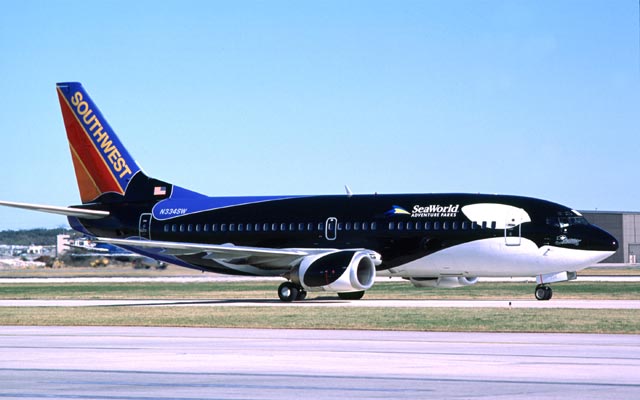 It's kinda cool. The inside is heavily decorated with SeaWorld advertising, too. Like all the overhead compartment doors are blue and watery looking, with either a SeaWorld logo or a picture of Shamu in action.
But this is the one I really want to fly on. I have no idea who sponsored it (or whether anyone did; they seem to have them for many states).
One of the things I appreciate about Southwest is their sense of whimsy. It's just more fun to fly with them (although I do miss the comical safety briefings they used to do...I assume the FAA decided it wasn't safe enough).
It's kinda cool. The inside is heavily decorated with SeaWorld advertising, too. Like all the overhead compartment doors are blue and watery looking, with either a SeaWorld logo or a picture of Shamu in action.But this is the one I really want to fly on. I have no idea who sponsored it (or whether anyone did; they seem to have them for many states).
One of the things I appreciate about Southwest is their sense of whimsy. It's just more fun to fly with them (although I do miss the comical safety briefings they used to do...I assume the FAA decided it wasn't safe enough).
Wednesday, August 27, 2008
Tuesday, August 19, 2008
Oh, Dear...
There's a disconnect in here somewhere. My fortune cookie from lunch today reads
You would do well in the field of computer technology.Now they tell me....
Breaking Ties
The summer of 1968 was a most exciting and memorable one in my family. Not so much because of all the assassinations, protests, riots and such, but mostly because we got to see it all in color for the first time. You see, in the summer of 1968, my grandfather bought himself a new color television, and gave us his old one as a hand-me-down.
The TV itself was a marvel to me, for all sorts of reasons I entirely take for granted nowadays. Not only were the pictures in color, but it had a remote control that could change the channel, volume, color and tint. I'm unclear which was more exciting: the discovery of channel surfing or the ability to make all the faces pink or green while sitting across the room.
Wow. Just wow.
The coolest thing from a modern, digital perspective was the way the remote control worked. The TV still had dials and knobs for changing channels and such, and the remote activated servos that turned the physical controls on the TV, so channel surfing still had the satisfying "clunk" of the old TV, plus you got to watch the knobs and dials move when you pushed buttons on the remote. Endless fun, really.
Two things we watched that summer probably shaped a lot of my future life: political conventions and the Olympics. I know there was other stuff on, but those are the ones I still remember vividly.
I certainly didn't understand much of the conventions, but the color, the bunting, the balloons, the big signs, the roll call of states with each delegation chairman trying to outdo the next with lavish praise for his home state before eventually casting the votes, the cheers: all made huge impressions. The sheer spectacle of American democracy at work was thrilling. I was also quite oblivious to all the protests and riots going on outside the convention hall. It was just the color and pageantry, the ritual, the excitement. I was hooked.
I'm sure that all had a lot to do with my later involvement in politics and government. By 1972, I was volunteering at the local party headquarters, and the substance of the convention and the nominating process was of interest. But every four years I still get quite a charge out of the memory of my first glimpse of a political convention.
The Olympics from Mexico City were something else altogether. In many ways, I think they were the first sporting event I was ever aware of. Neither of my parents ever gave a damn about sports (although Dad eventually paid attention because I was a sports nut; kind of a weird reversal of the way that usually happens, I think). But every four years, there they were, glued to the set, watching and following and rooting.
As with the conventions, I think it was the spectacle of the Olympics that caught my interest. I don't remember any particular events, just all of this weird, unaccustomed stuff on the TV, and my parents sitting and watching it, making time in their lives for this big event. Again, by 1972 I was actually interested in sports and the content of the games. But in 1968, I was hooked.
All of this is a very long-winded introduction to the topic that prompted me to write today, which is the current foofaraw over scoring in Olympic gymnastics. It always sort of amuses me that the two most popular Olympic sports on U.S. television, gymnastics and ice skating, share (at least) two things in common: almost no one pays any attention to them outside of the Olympics, and all these fair-weather fans seem to have strong opinions about the arcane and subjective scoring systems that govern the sports.
As far as I can tell, the one constant in the Olympic universe is controversy over the scoring of those two sports. The recent fuss over the tie breaker in women's gymnastics is just the latest example. And everyone seems to have their own opinion as to what must be done.
I come at this from the perspective not of an athlete, but as a former competitor and coach/administrator in forensics (speech and debate). The issues are similar, if not as much fun to watch on television. From the competitor's standpoint, you need to know what the rules are, and you want to know that they are applied fairly. As an administrator, you sometimes need to be able to break a tie score, as you sometimes need to come up with a particular number of winners at some stage in the competition.
As my wife and I discussed this last night, we both recalled instances when we were competing and tie-breakers came into play. In both cases we remembered being eliminated from competitions on the basis of tie-breakers. And I certainly remember applying tie-breaking rules a number of times when I was running tournaments. It's never desirable, but sometimes necessary.
This brings to mind two points about the gymnastics controversy:
The TV itself was a marvel to me, for all sorts of reasons I entirely take for granted nowadays. Not only were the pictures in color, but it had a remote control that could change the channel, volume, color and tint. I'm unclear which was more exciting: the discovery of channel surfing or the ability to make all the faces pink or green while sitting across the room.
Wow. Just wow.
The coolest thing from a modern, digital perspective was the way the remote control worked. The TV still had dials and knobs for changing channels and such, and the remote activated servos that turned the physical controls on the TV, so channel surfing still had the satisfying "clunk" of the old TV, plus you got to watch the knobs and dials move when you pushed buttons on the remote. Endless fun, really.
Two things we watched that summer probably shaped a lot of my future life: political conventions and the Olympics. I know there was other stuff on, but those are the ones I still remember vividly.
I certainly didn't understand much of the conventions, but the color, the bunting, the balloons, the big signs, the roll call of states with each delegation chairman trying to outdo the next with lavish praise for his home state before eventually casting the votes, the cheers: all made huge impressions. The sheer spectacle of American democracy at work was thrilling. I was also quite oblivious to all the protests and riots going on outside the convention hall. It was just the color and pageantry, the ritual, the excitement. I was hooked.
I'm sure that all had a lot to do with my later involvement in politics and government. By 1972, I was volunteering at the local party headquarters, and the substance of the convention and the nominating process was of interest. But every four years I still get quite a charge out of the memory of my first glimpse of a political convention.
The Olympics from Mexico City were something else altogether. In many ways, I think they were the first sporting event I was ever aware of. Neither of my parents ever gave a damn about sports (although Dad eventually paid attention because I was a sports nut; kind of a weird reversal of the way that usually happens, I think). But every four years, there they were, glued to the set, watching and following and rooting.
As with the conventions, I think it was the spectacle of the Olympics that caught my interest. I don't remember any particular events, just all of this weird, unaccustomed stuff on the TV, and my parents sitting and watching it, making time in their lives for this big event. Again, by 1972 I was actually interested in sports and the content of the games. But in 1968, I was hooked.
All of this is a very long-winded introduction to the topic that prompted me to write today, which is the current foofaraw over scoring in Olympic gymnastics. It always sort of amuses me that the two most popular Olympic sports on U.S. television, gymnastics and ice skating, share (at least) two things in common: almost no one pays any attention to them outside of the Olympics, and all these fair-weather fans seem to have strong opinions about the arcane and subjective scoring systems that govern the sports.
As far as I can tell, the one constant in the Olympic universe is controversy over the scoring of those two sports. The recent fuss over the tie breaker in women's gymnastics is just the latest example. And everyone seems to have their own opinion as to what must be done.
I come at this from the perspective not of an athlete, but as a former competitor and coach/administrator in forensics (speech and debate). The issues are similar, if not as much fun to watch on television. From the competitor's standpoint, you need to know what the rules are, and you want to know that they are applied fairly. As an administrator, you sometimes need to be able to break a tie score, as you sometimes need to come up with a particular number of winners at some stage in the competition.
As my wife and I discussed this last night, we both recalled instances when we were competing and tie-breakers came into play. In both cases we remembered being eliminated from competitions on the basis of tie-breakers. And I certainly remember applying tie-breaking rules a number of times when I was running tournaments. It's never desirable, but sometimes necessary.
This brings to mind two points about the gymnastics controversy:
- As far as I can tell, the tie-breaking rules were followed fairly and appropriately. Most of the issues I heard discussed had to do with the quality of the judging that produced the weird tie, and a little about whether the tie-breaking formula was a good one. I heard no indication that the tie was improperly broken.
- Perhaps more importantly, it is entirely unclear to me why the tie needed to be broken (other than the fact that the rules said so). Other sports allow ties in the Olympics, and there seems to be no harm in awarding two gold medals in a particular apparatus. It's not as if a single winner needs to advance to another level of competition or something.
Wednesday, July 30, 2008
Monday, July 28, 2008
Appalling. Sickening.
Came across this transcript of Bill Moyers' interview with Jane Mayer.
There are plenty of disgusting bits, but here are some lowlights:
And what happens when you start trying to make excuses and exceptions?
There are plenty of disgusting bits, but here are some lowlights:
Yup. Making up the rules as they go along, and obfuscating their tracks. Sounds about right.JANE MAYER: Well, I think they knew they were being asked about torture. I mean, they danced around the question. They've redefined the term "torture" so that what was torture before 9/11 they say has not been torture since.
BILL MOYERS: Why?
JANE MAYER: Because they wanted to interrogate people in completely brutal ways. And they wanted to avoid being accused of war crimes. So one of the witnesses there, Doug Feith in particular, who was the number three in the Pentagon, argued right after 9/11 that the Geneva Convention should no longer apply to anybody that was picked up in the war on terror, that was a terrorist suspect. And so they took away the rules of war, which were the Geneva Conventions, which America really pioneered in many ways. And they also said that the criminal laws didn't apply to the same suspects. So they were left with kind of a legal limbo. And they made up the laws as they went along on it.
And what happens when you start trying to make excuses and exceptions?
JANE MAYER: Well, there are a couple of things I want to say about this. One is to say that there's a special exception here: We won't torture except when we will torture, is a legal problem. The convention against torture, which the United States Senate ratified, has no exceptions. It's a major felony. There's no excuse for doing it for war. There's no excuse for national security. It doesn't have exceptions. So this is a serious legal problem.But it's not just the legality, it's also what it does to the moral fiber of the society:
BILL MOYERS: Torture can become an accepted way of life for a society. I mean, you can get used to it. Or you can know it's going on and realizing that it doesn't affect you, so it doesn't matter to you. Do you is there a possibility that that's happening here?
JANE MAYER: Well, you know, there's a great book out called, "Torture and Democracy," by Darius Rejali, which is about how torture has worked over the years. And one of the things he writes about is that it has a very corrupting effect on a society and also on military discipline, on anybody involved in it. There's this tendency to get rougher and rougher. You don't get the answer you want? You up the level of aggression. It also has a horrific effect on the outlook of the people who were involved in this program there and I do describe how one of the interrogators in particular who did waterboarding with the CIA is wracked by nightmares now according to one of his friends. He - you can't go to that dark place without it affecting you.
I've said it many times before (and I'm tired of it, but it's important): torture is wrong. It's always wrong. And every justification given for it inevitably reflects the corruption that such mistreatment engenders.
Friday, July 25, 2008
Having Fun While Dying
Randy Pausch died today. Cancer claims another victim, and as usual, one much too young. This one hits very close to home for me, as he was almost exactly my age. And that is, by definition, much too young to die.
By now, probably everybody on the Internet has seen Randy's last lecture or one of its derivatives. It was a wonderful performance, and one that I hope will be meaningful to its intended audience, his children. But I know it touched a lot of people, including me.
One of the many nuggets I retained from his lecture was his notion about having fun every day, even while dying (and after all, we are all of us dying, every day, in some respect). It's a lesson we should all remember.
Take care of yourselves and your loved ones, and live strong.
By now, probably everybody on the Internet has seen Randy's last lecture or one of its derivatives. It was a wonderful performance, and one that I hope will be meaningful to its intended audience, his children. But I know it touched a lot of people, including me.
One of the many nuggets I retained from his lecture was his notion about having fun every day, even while dying (and after all, we are all of us dying, every day, in some respect). It's a lesson we should all remember.
Take care of yourselves and your loved ones, and live strong.
Thursday, July 17, 2008
Energy Independence
OK, time to write something that isn't about vacation!
Forgive me if I ramble a bit. I see that Al Gore has thrown down the gauntlet on energy independence, or at least on the electricity front. His proposal to stop using fossil fuels (other than "clean coal") to generate electricity has merit on a lot of levels. It would free fossil fuels for potentially better uses, or at least ones that are harder to substitute.
I assume he intentionally timed his challenge to coincide with the anniversary of Jimmy Carter's famous address on energy independence (hat tip to Jonathan Schwartz for pointing that out). Jimmy made some amazing statements at the time:
When Carter delivered that speech in July of 1979, I had just graduated from high school, and during my senior year, as a member of the debate team we had debated the question of how the U.S. could increase its energy independence.
Interestingly, my partner and I spent the first half of the year advocating increased use of nuclear power, claiming it was far cleaner and safer than fossil fuels when you consider the entire fuel cycle. Then came the exciting convergence of Three Mile Island and the movie, The China Syndrome. Suddenly advocating nukes wasn't quite as palatable. So we turned 180 degrees and argued for banning and decommissioning all the nukes and replacing them with thermal energy generation retrofits on existing hydroelectric facilities. That was a bit esoteric, and probably not truly feasible on a national scale, but it was a lot of fun to debate.
Ultimately, the case I found most convincing (and hardest to defeat) that year was advocacy for energy conservation. There are very few good arguments against being more efficient in our use of existing energy sources.
And by far the most fascinating part of the energy debate to me was the argument over energy use and its effect on global climate. My research on the topic ultimately led me to major in Environmental Science and pursue (briefly) a career in public policy and government.
And now, nearly 30 years later, climate change is a common topic of conversation. Go figure.
What's amazing to me is how badly we've slid backward on energy. When Carter made his speech, he wanted to cut oil imports by half, "a saving of over 4-1/2 million barrels of imported oil per day." So imports were on the order of 9 million barrels per day. The CIA reported in 2004 that imports were running around 13.15 million barrels per day, and the U.S. Energy Information Agency now says that in 2006, net imports ran to 12,390,000 barrels per day.
Now, those aren't all equivalent numbers. The U.S. exports around a million barrels of oil a day, too, so the CIA and DOE numbers are pretty close. In any case, we're now importing on the order of 50% more, not the 50% less that Carter set as the goal.
Heck of a job, guys.
Forgive me if I ramble a bit. I see that Al Gore has thrown down the gauntlet on energy independence, or at least on the electricity front. His proposal to stop using fossil fuels (other than "clean coal") to generate electricity has merit on a lot of levels. It would free fossil fuels for potentially better uses, or at least ones that are harder to substitute.
I assume he intentionally timed his challenge to coincide with the anniversary of Jimmy Carter's famous address on energy independence (hat tip to Jonathan Schwartz for pointing that out). Jimmy made some amazing statements at the time:
Point one: I am tonight setting a clear goal for the energy policy of the United States. Beginning this moment, this nation will never use more foreign oil than we did in 1977 -- never. From now on, every new addition to our demand for energy will be met from our own production and our own conservation.Yeah, that worked out real well.
When Carter delivered that speech in July of 1979, I had just graduated from high school, and during my senior year, as a member of the debate team we had debated the question of how the U.S. could increase its energy independence.
Interestingly, my partner and I spent the first half of the year advocating increased use of nuclear power, claiming it was far cleaner and safer than fossil fuels when you consider the entire fuel cycle. Then came the exciting convergence of Three Mile Island and the movie, The China Syndrome. Suddenly advocating nukes wasn't quite as palatable. So we turned 180 degrees and argued for banning and decommissioning all the nukes and replacing them with thermal energy generation retrofits on existing hydroelectric facilities. That was a bit esoteric, and probably not truly feasible on a national scale, but it was a lot of fun to debate.
Ultimately, the case I found most convincing (and hardest to defeat) that year was advocacy for energy conservation. There are very few good arguments against being more efficient in our use of existing energy sources.
And by far the most fascinating part of the energy debate to me was the argument over energy use and its effect on global climate. My research on the topic ultimately led me to major in Environmental Science and pursue (briefly) a career in public policy and government.
And now, nearly 30 years later, climate change is a common topic of conversation. Go figure.
What's amazing to me is how badly we've slid backward on energy. When Carter made his speech, he wanted to cut oil imports by half, "a saving of over 4-1/2 million barrels of imported oil per day." So imports were on the order of 9 million barrels per day. The CIA reported in 2004 that imports were running around 13.15 million barrels per day, and the U.S. Energy Information Agency now says that in 2006, net imports ran to 12,390,000 barrels per day.
Now, those aren't all equivalent numbers. The U.S. exports around a million barrels of oil a day, too, so the CIA and DOE numbers are pretty close. In any case, we're now importing on the order of 50% more, not the 50% less that Carter set as the goal.
Heck of a job, guys.
Wednesday, July 16, 2008
Footnote to Yucatan Trip
Back home safely. Can't say I was terribly impressed with Mexicana Airlines or their budget domestic buddy, Click. But they got me home, and that's what counts.
While we were staying at Xamach Dos near Tulum and the Sian Ka'an biosphere preserve, we heard news about PROFEPA, sort of the Mexican version of the U.S. EPA, seizing and closing a bunch of local hotels for reasons that were not entirely clear. Speculation ran to all sorts of possibilities ranging from actual environmental degradation to land grab.
I found some local discussion today, so thought I would link to it. Sounds like the locals don't know much, either. We had met some nice folks who were staying at the Diamante K earlier in the week, and I hope they were gone before the place got closed down.
Exciting times, but I gather this is one of the ongoing issues when foreign people "buy" property in Mexico.
While we were staying at Xamach Dos near Tulum and the Sian Ka'an biosphere preserve, we heard news about PROFEPA, sort of the Mexican version of the U.S. EPA, seizing and closing a bunch of local hotels for reasons that were not entirely clear. Speculation ran to all sorts of possibilities ranging from actual environmental degradation to land grab.
I found some local discussion today, so thought I would link to it. Sounds like the locals don't know much, either. We had met some nice folks who were staying at the Diamante K earlier in the week, and I hope they were gone before the place got closed down.
Exciting times, but I gather this is one of the ongoing issues when foreign people "buy" property in Mexico.
Sunday, July 13, 2008
Festivities and Shopping
Free advice: If you stay at the Hotel Dolores Alba in Merida, don't eat the 50 peso breakfast buffet. 'Nuff said.
We set out last night in the rain to get dinner. Found a recommended restaurant called Pancho's, with sort of a Pancho Villa theme. Although it seemed to cater largely to Americans (and what business here doesn't?), it had quite authentic flavors, and the food was universally excellent. We tried their tuna ceviche, beef quesadilla, pepper steak, and chimichangas, and all were delicious.
By the time we left, the rain had stopped, and there was some outdoor activity, but nothing to the degree that would be normal. Some clowns on the zocalo gave my daughter a fancy balloon animal, but that was about the extent of things last night.
This morning we went out in search of hammocks. The recommended stores are closed on Sunday, so we looked at a few other places. We eventually bought a huge blue one made of silk. It's quite lovely, and easily holds the whole family. The negotiation process was interesting, but that is something my wife is very good at. She thinks we could have gotten an even better deal if we'd had more time, but I needed to get to the airport.
So here I am, sitting in the departure lounge with an hour to spare, trying to figure out the wifi system where all the pages seem to be in Spanish. I was hoping to do a little research on the web while I wait, but perhaps I'll just get started on my reading (and this writing, of course).
We set out last night in the rain to get dinner. Found a recommended restaurant called Pancho's, with sort of a Pancho Villa theme. Although it seemed to cater largely to Americans (and what business here doesn't?), it had quite authentic flavors, and the food was universally excellent. We tried their tuna ceviche, beef quesadilla, pepper steak, and chimichangas, and all were delicious.
By the time we left, the rain had stopped, and there was some outdoor activity, but nothing to the degree that would be normal. Some clowns on the zocalo gave my daughter a fancy balloon animal, but that was about the extent of things last night.
This morning we went out in search of hammocks. The recommended stores are closed on Sunday, so we looked at a few other places. We eventually bought a huge blue one made of silk. It's quite lovely, and easily holds the whole family. The negotiation process was interesting, but that is something my wife is very good at. She thinks we could have gotten an even better deal if we'd had more time, but I needed to get to the airport.
So here I am, sitting in the departure lounge with an hour to spare, trying to figure out the wifi system where all the pages seem to be in Spanish. I was hoping to do a little research on the web while I wait, but perhaps I'll just get started on my reading (and this writing, of course).
Saturday, July 12, 2008
Ruin and Rain
Last night we stayed over at the Hotel Dolores Alba in Chichen Itza. This evening I find myself writing at the Hotel Dolores Alba in Mérida, the capital of the state of Yucatan. We headed here, rather than staying at Chichen Itza another night, since Margo at Xamach Dos raved about how great the Saturday night fiesta in Merida is. Sounded good to us, so here we are. Just as we arrived at the hotel, having found our way through Mérida, it started to rain. And rain. And rain. With some lightning and thunder thrown in for good measure.
It has largely let up now, but the streets are wet, wet, wet, and we're uncertain whether we want to brave that. Looks like we'll head out for some dinner first, then decide. I suppose it is worth noting that this is the first significant rain we have encountered. Lots of little, brief squalls, especially at night, while we were in Sian Ka'an, but this was quite heavy and prolonged.
But back to Chichen Itza, as promised. We went back to the park this morning, fully intending to wander around without a guide. Having done two other Mayan archeology sites yesterday, read the guide book on Chichen Itza, and gone to the evening light show, we had the notion we could see what we wanted, then hit the road.
The first guide to hit us up for business really rubbed us wrong, so we moved on, paid for our tickets, and entered the gates. Then another guide asked if we wanted one, but we declined again. He said fine, but if we were hungry later, to go to his wife's restaurant in nearby Piste, and gave us her card. He was very nice, and eventually we decided to hire him. Good choice.
Javier turned out to be a fine guide, and rather than regurgitating all we'd heard at the other sites and read in the book, he took us around relatively quickly, showing us nuances we might miss otherwise, such as places where there are interesting echoes or remnants of original paint. He emphasized the Mayan aspects of Chichen Itza and downplayed the Toltec aspects (perhaps because he's Mayan himself). As he finished our tour he made suggestions for how we might want to proceed to see other parts of the site he hadn't taken us to. As a result, we had a really good visit to the site, and feel we got a lot out of it.
I have to say, at the end of a week of touring, that I have immense respect for these guys who do tours in English here in Mexico. Many of them have relatively little formal instruction in English, but do a great job presenting their practiced pieces as well as answering questions. Nearly all of our experiences this trip have been very positive.
Leaving Chichen Itza park, we still had to checkout of our hotel, then rushed over to Balankanche Cave for the 1:00 pm tour in English. The cave is quite nice, but there was a big crowd, most of whom spoke Spanish, and therefore ignored the recorded story in English. This (along with marginal recording quality) made it pretty difficult to hear what was going on. As near as I could make out, it was a dramatization of a Mayan father taking his son down into the cave for the first time to see the offerings that others had made, and explaining the history and traditions behind it all. Might have been pretty interesting, but as I say, it was largely unintelligible.
The cave itself is spacious and easy to get through. Nothing uncomfortable or claustrophobic. Some of the limestone formations are quite lovely, and there are plenty of cute little bats flying and hanging. The various offerings are somewhat interesting, though again, I couldn't make out much of the explanations. All that said, I've been in better caves, and it gets very hot and muggy down inside this one. I wouldn't put it at the top of my list of things to do here.
As a footnote, we did, in fact, head over to Javier's wife's restaurant before leaving for Mérida. It's kind of at the far end of Piste, away from the tourist hotels, and seems to be more of a place for locals (or at least Mexicans) than American tourists. But we introduced ourselves, said that Javier had told us to come by, and we had a very nice, tasty, inexpensive meal. If you're in the neighborhood of Chichen Itza, you could definitely do worse than dining at the Loncheria Fabiola. It's on the main highway, opposite a big restaurant called the Atrio.
Tomorrow I have to head home. The rest of the family is staying to see some more ruins and things on this end of the Yucatan. But I need to get home to do some work.
It has largely let up now, but the streets are wet, wet, wet, and we're uncertain whether we want to brave that. Looks like we'll head out for some dinner first, then decide. I suppose it is worth noting that this is the first significant rain we have encountered. Lots of little, brief squalls, especially at night, while we were in Sian Ka'an, but this was quite heavy and prolonged.
But back to Chichen Itza, as promised. We went back to the park this morning, fully intending to wander around without a guide. Having done two other Mayan archeology sites yesterday, read the guide book on Chichen Itza, and gone to the evening light show, we had the notion we could see what we wanted, then hit the road.
The first guide to hit us up for business really rubbed us wrong, so we moved on, paid for our tickets, and entered the gates. Then another guide asked if we wanted one, but we declined again. He said fine, but if we were hungry later, to go to his wife's restaurant in nearby Piste, and gave us her card. He was very nice, and eventually we decided to hire him. Good choice.
Javier turned out to be a fine guide, and rather than regurgitating all we'd heard at the other sites and read in the book, he took us around relatively quickly, showing us nuances we might miss otherwise, such as places where there are interesting echoes or remnants of original paint. He emphasized the Mayan aspects of Chichen Itza and downplayed the Toltec aspects (perhaps because he's Mayan himself). As he finished our tour he made suggestions for how we might want to proceed to see other parts of the site he hadn't taken us to. As a result, we had a really good visit to the site, and feel we got a lot out of it.
I have to say, at the end of a week of touring, that I have immense respect for these guys who do tours in English here in Mexico. Many of them have relatively little formal instruction in English, but do a great job presenting their practiced pieces as well as answering questions. Nearly all of our experiences this trip have been very positive.
Leaving Chichen Itza park, we still had to checkout of our hotel, then rushed over to Balankanche Cave for the 1:00 pm tour in English. The cave is quite nice, but there was a big crowd, most of whom spoke Spanish, and therefore ignored the recorded story in English. This (along with marginal recording quality) made it pretty difficult to hear what was going on. As near as I could make out, it was a dramatization of a Mayan father taking his son down into the cave for the first time to see the offerings that others had made, and explaining the history and traditions behind it all. Might have been pretty interesting, but as I say, it was largely unintelligible.
The cave itself is spacious and easy to get through. Nothing uncomfortable or claustrophobic. Some of the limestone formations are quite lovely, and there are plenty of cute little bats flying and hanging. The various offerings are somewhat interesting, though again, I couldn't make out much of the explanations. All that said, I've been in better caves, and it gets very hot and muggy down inside this one. I wouldn't put it at the top of my list of things to do here.
As a footnote, we did, in fact, head over to Javier's wife's restaurant before leaving for Mérida. It's kind of at the far end of Piste, away from the tourist hotels, and seems to be more of a place for locals (or at least Mexicans) than American tourists. But we introduced ourselves, said that Javier had told us to come by, and we had a very nice, tasty, inexpensive meal. If you're in the neighborhood of Chichen Itza, you could definitely do worse than dining at the Loncheria Fabiola. It's on the main highway, opposite a big restaurant called the Atrio.
Tomorrow I have to head home. The rest of the family is staying to see some more ruins and things on this end of the Yucatan. But I need to get home to do some work.
Friday, July 11, 2008
My Day in Ruins
Hit the road early this morning, because we had a lot to cover. First stop, the archaeological site at Tulum, which is just back up to the main road, so 32 km from Xamach Dos. So after a quick breakfast and a good-bye to Margo, we embarked.
The Tulum park opens at 8:00 am, and we got there just after that. Before, it turns out, any English-speaking guides had shown up. But shortly after we started walking on our own, they sent Santiago after us, and he was worth waiting for. Tulum was an important Mayan trading center, right on the coast. It was one of the first Mayan cities spotted by the Spanish, in fact, because the walled city was clearly visible from the water.
Many of the ruins within the wall have been restored or at least uncovered, and you can kind of get a feel for what the layout of the city was like and why it mattered. Santiago told us a lot about Mayan culture and social structure that would reverberate later in the day. Highlights of the tour included great views of the big ruins, the view out over the Caribbean Sea, and several tie-ins with things we'd learned from the Mayan guides from Community Tours earlier in the week.
Then back on the bus for a couple of quick errands in the town of Tulum before heading out to Coba.
Coba wasn't on our original itinerary, but after a friend strongly urged that we should go there, even over some of the other, more famous sites, we added it in today. Great decision (and thanks, Steve!). Coba is a neat site, and unlike some of the others, they haven't cleared the jungle out, so among other things, there is some shade that keeps things cooler. Also, they let you climb to the top of the second-highest Mayan pyramid (the highest being at Tikal in Guatemala) anywhere, and you get a spectacular view over the jungle canopy. Very cool, and well worth the climb.
We also got to rent bikes to ride around between some of the more far-flung ruins, which is definitely more fun than walking in the midday heat. We got a pretty good look at a couple of ball fields, where they used to play the ritual Mayan ballgames. We had seen the demonstration at Xcaret earlier, but this gave a better sense of the context of the games within Mayan society.
After a quick bite of lunch, we climbed back aboard the van and headed for Chichen Itza, by far the most famous Mayan site, at least in Mexico.
First stop was our hotel, where we immediately hopped into the pool for a dip and then luxuriated in the showers for a bit. (For all its beauty, Xamach Dos was very rustic, and the showers were a bit weak.) After a week, it felt good to have a strong shower again! Then a very quick bite of dinner, then off to Chichen Itza park, where they do a light and sound show. It was spectacular, of course. The ruins are very beautiful and well restored, and the grounds are lovely and well kept, so the bright colored lights make for quite a show. I didn't really learn anything that I hadn't already read in the guidebook, but I now have a good feel for what to see tomorrow when we go back in the daylight.
We went for the “simultaneous translation” option, which was OK when it worked, but very direction-sensitive and a bit fussy. Add to this that some of the family stopped to watch at a spot that turned out to be an ant hill, and you have some hilarity. My wife moved from the ant hill to stand on a log, and found herself being surrounded by flying bats (very cool!).
After the show, my daughter found a trail of leafcutter ants, and we tracked them for a ways with a little penlight. Those are some hard-working little dudes!
So it was a very busy day, with three major sites and a lot of transit, but it was fun and worthwhile. We got some insights into Mayan class structure (hint: it's good to be the king!) and history.
More on Chichen Itza after tomorrow's visit.
The Tulum park opens at 8:00 am, and we got there just after that. Before, it turns out, any English-speaking guides had shown up. But shortly after we started walking on our own, they sent Santiago after us, and he was worth waiting for. Tulum was an important Mayan trading center, right on the coast. It was one of the first Mayan cities spotted by the Spanish, in fact, because the walled city was clearly visible from the water.
Many of the ruins within the wall have been restored or at least uncovered, and you can kind of get a feel for what the layout of the city was like and why it mattered. Santiago told us a lot about Mayan culture and social structure that would reverberate later in the day. Highlights of the tour included great views of the big ruins, the view out over the Caribbean Sea, and several tie-ins with things we'd learned from the Mayan guides from Community Tours earlier in the week.
Then back on the bus for a couple of quick errands in the town of Tulum before heading out to Coba.
Coba wasn't on our original itinerary, but after a friend strongly urged that we should go there, even over some of the other, more famous sites, we added it in today. Great decision (and thanks, Steve!). Coba is a neat site, and unlike some of the others, they haven't cleared the jungle out, so among other things, there is some shade that keeps things cooler. Also, they let you climb to the top of the second-highest Mayan pyramid (the highest being at Tikal in Guatemala) anywhere, and you get a spectacular view over the jungle canopy. Very cool, and well worth the climb.
We also got to rent bikes to ride around between some of the more far-flung ruins, which is definitely more fun than walking in the midday heat. We got a pretty good look at a couple of ball fields, where they used to play the ritual Mayan ballgames. We had seen the demonstration at Xcaret earlier, but this gave a better sense of the context of the games within Mayan society.
After a quick bite of lunch, we climbed back aboard the van and headed for Chichen Itza, by far the most famous Mayan site, at least in Mexico.
First stop was our hotel, where we immediately hopped into the pool for a dip and then luxuriated in the showers for a bit. (For all its beauty, Xamach Dos was very rustic, and the showers were a bit weak.) After a week, it felt good to have a strong shower again! Then a very quick bite of dinner, then off to Chichen Itza park, where they do a light and sound show. It was spectacular, of course. The ruins are very beautiful and well restored, and the grounds are lovely and well kept, so the bright colored lights make for quite a show. I didn't really learn anything that I hadn't already read in the guidebook, but I now have a good feel for what to see tomorrow when we go back in the daylight.
We went for the “simultaneous translation” option, which was OK when it worked, but very direction-sensitive and a bit fussy. Add to this that some of the family stopped to watch at a spot that turned out to be an ant hill, and you have some hilarity. My wife moved from the ant hill to stand on a log, and found herself being surrounded by flying bats (very cool!).
After the show, my daughter found a trail of leafcutter ants, and we tracked them for a ways with a little penlight. Those are some hard-working little dudes!
So it was a very busy day, with three major sites and a lot of transit, but it was fun and worthwhile. We got some insights into Mayan class structure (hint: it's good to be the king!) and history.
More on Chichen Itza after tomorrow's visit.
Thursday, July 10, 2008
Farewell to Xamach Dos
Today, my daughter and I are both feeling under the weather, so we're staying home while the rest of the gang goes off to tour Punta Allen, farther down into the Sian Ka'an reserve. They've gone with the same Community Tours Sian Ka'an group that we went with to Muyil earlier in the week. The agenda involves snorkeling on the reef, walking through (or perhaps near to) a bird nesting area, more cenotes, and some discussion of the hydrological system of the Yucatan (and perhaps how it affects the local manatees). That last I would particularly have enjoyed, but my sinuses are in full revolt, so reading in a hammock and tending to my ailing daughter are about my limit.
On the plus side, this being our last day and night here at Xamach Dos, we got a reprise of everyone's favorite breakfast (banana pancakes with fresh shaved coconut and maple syrup). (And yes, I know that maple syrup is not indigenous to this area. But it's so good on that meal!) And for dinner tonight, we revisit the lobsters, which were so tasty the other night. So no complaints.
I suppose I should try to summarize my reactions to Xamach Dos. In short, I enjoyed it a lot. It's not fancy, and it's quite remote. There are many, many hammocks, plus lots of beach chairs. Coconut palms, nice clean beach (with land crabs), friendly puppy (Sally) and cat (Meow-Meow). Margo and her staff are quite accommodating, adapting to meal preferences and schedules.
I really appreciate the fact that all the electrical power comes from solar panels and batteries. Goodness knows they get plenty of sunshine! And the owners have placed a number of little solar lights around the resort to make sure one can find one's way in the darkness.
If I have one complaint, it might be that there isn't very much water. I forgot to ask whether it comes from a well or from some kind of desalination plant, but the flow of water in our cabana, at least, was a little feeble. I'm looking forward to a good strong shower at a hotel this weekend!
Oh, about the name Xamach Dos: xamach is apparently the name of the pan used to cook tortillas, and just south of where we are staying is Punta Xamach. So apparently this is the second tract of land in the area. Or so Margo tells me.
On the plus side, this being our last day and night here at Xamach Dos, we got a reprise of everyone's favorite breakfast (banana pancakes with fresh shaved coconut and maple syrup). (And yes, I know that maple syrup is not indigenous to this area. But it's so good on that meal!) And for dinner tonight, we revisit the lobsters, which were so tasty the other night. So no complaints.
I suppose I should try to summarize my reactions to Xamach Dos. In short, I enjoyed it a lot. It's not fancy, and it's quite remote. There are many, many hammocks, plus lots of beach chairs. Coconut palms, nice clean beach (with land crabs), friendly puppy (Sally) and cat (Meow-Meow). Margo and her staff are quite accommodating, adapting to meal preferences and schedules.
I really appreciate the fact that all the electrical power comes from solar panels and batteries. Goodness knows they get plenty of sunshine! And the owners have placed a number of little solar lights around the resort to make sure one can find one's way in the darkness.
If I have one complaint, it might be that there isn't very much water. I forgot to ask whether it comes from a well or from some kind of desalination plant, but the flow of water in our cabana, at least, was a little feeble. I'm looking forward to a good strong shower at a hotel this weekend!
Oh, about the name Xamach Dos: xamach is apparently the name of the pan used to cook tortillas, and just south of where we are staying is Punta Xamach. So apparently this is the second tract of land in the area. Or so Margo tells me.
Wednesday, July 09, 2008
Downtime and Adventure Play

Yesterday we went to a lower-key adventure park called Hidden Worlds. Built around a system of cenotes and related caves and such, they've created a park in which one can snorkel, rappel, ride a zip line (two different ones, actually, including one that ends in a spectacular splashdown in an underground cave), and a “sky cycle” through the jungle. Not only is it much closer to our base camp, but it also does things in a smaller, friendlier atmosphere than Xcaret. The whole setup is run by maybe a couple of dozen people, and since the “crowds” are small, they manage very personalized, hands-on service. Things go at rather a more relaxed pace, but that's OK.
And today, more downtime! Hammocks, dozing, and playing in the water.
But first, we went over to look at the ruins across the road. They're small and not terribly distinguished, but they're interesting and easy to get to. It's amazing how hot and humid it is just a few hundred meters away from the beach.
After lunch, my wife and I borrowed a two-seat sea kayak (my first experience on a kayak) to paddle out to the barrier reef that protects our little bay, where we anchored it and snorkeled around a bit. The reef is not spectacular (there might be spectacular parts, but not where we ended up), but we saw plenty of little fish, interesting corals, and a couple of small lobsters. I spotted a number of the little flamingo-tongue snails that live on gorgonian corals.
All in all, a very pleasant way to spend the day. That's what vacation's all about.
Monday, July 07, 2008
Xcaret and Lobsters
Yesterday's adventure was a trip to Xcaret, which is sort of a theme park built around some Mayan ruins, a cenote (fresh-water spring/cave) and some other items. They've made it into quite a nice place, not at all as tacky as I'd been imagining.
First stop in the morning (after driving two hours to get to Xcaret) was the desk where we could arrange various specific activities for the day. As it turned out, the only one people wanted to do was the dolphin encounter. My wife, our daughter, and my mother-in-law all decided to go swim with the dolphins. Having had some fine, natural close encounters with dolphins on our recent Galapagos trip, I decided to forgo this.
They seemed to enjoy their swim. They certainly got up close and personal with the dolphins, but I had to feel that the animals weren't having much fun. I watched them playing with each other between groups of tourists, and they seemed quite pleased with that. During their human encounters, one definitely had the impression they were much more interested in their fish bribes than in whatever was going on with the visitors.
Xcaret has a number of quite impressive animal exhibits, including a natural bat cave, a manatee lagoon, a tapir, some spider monkeys, and a very nice aquarium that features terrific sea turtles, from very small to very large. And as usual in non-U.S. parks, you get a lot closer to most of the critters, which is nice.
At dinner time, we went to the big production show, covering some of the local Mayan history and culture, the Spanish arrival, and the breadth of the blended Mexican culture. The Mayan portion was quite good, including demonstrations of traditional Mayan ballgames, including one much like field hockey or lacrosse, other than the fact that the ball is aflame. Very cool. They kind of gloss over the details of the Spanish-Mayan "cultural exchanges" that eventually produced modern Mexico, making it all sound very easy and peaceful. But they do paint quite a picture of the rich variety of modern Mexican culture.
Today, downtime. I had to beg and plead to schedule a couple of days where we would not plan side trips and excursions, just rest and enjoy this lovely place where we're staying. This goes against the nature of my wife and her mother, who arranged the trip. But they have grudgingly allowed me a small amount of time to enjoy the hammocks on the beach.
So it's a lovely day of sitting and/or lying in various hammocks, reading books, walking on the beach. And then the much anticipated dinner: fresh, local lobsters! Absolutely delicious, grilled to perfection, and served with a tasty cheese pasta. Days don't get much better than this.
First stop in the morning (after driving two hours to get to Xcaret) was the desk where we could arrange various specific activities for the day. As it turned out, the only one people wanted to do was the dolphin encounter. My wife, our daughter, and my mother-in-law all decided to go swim with the dolphins. Having had some fine, natural close encounters with dolphins on our recent Galapagos trip, I decided to forgo this.
They seemed to enjoy their swim. They certainly got up close and personal with the dolphins, but I had to feel that the animals weren't having much fun. I watched them playing with each other between groups of tourists, and they seemed quite pleased with that. During their human encounters, one definitely had the impression they were much more interested in their fish bribes than in whatever was going on with the visitors.
Xcaret has a number of quite impressive animal exhibits, including a natural bat cave, a manatee lagoon, a tapir, some spider monkeys, and a very nice aquarium that features terrific sea turtles, from very small to very large. And as usual in non-U.S. parks, you get a lot closer to most of the critters, which is nice.
At dinner time, we went to the big production show, covering some of the local Mayan history and culture, the Spanish arrival, and the breadth of the blended Mexican culture. The Mayan portion was quite good, including demonstrations of traditional Mayan ballgames, including one much like field hockey or lacrosse, other than the fact that the ball is aflame. Very cool. They kind of gloss over the details of the Spanish-Mayan "cultural exchanges" that eventually produced modern Mexico, making it all sound very easy and peaceful. But they do paint quite a picture of the rich variety of modern Mexican culture.
Today, downtime. I had to beg and plead to schedule a couple of days where we would not plan side trips and excursions, just rest and enjoy this lovely place where we're staying. This goes against the nature of my wife and her mother, who arranged the trip. But they have grudgingly allowed me a small amount of time to enjoy the hammocks on the beach.
So it's a lovely day of sitting and/or lying in various hammocks, reading books, walking on the beach. And then the much anticipated dinner: fresh, local lobsters! Absolutely delicious, grilled to perfection, and served with a tasty cheese pasta. Days don't get much better than this.
Sunday, July 06, 2008
Working for The Man
Yesterday was tour day within Sian Ka'an. We were picked up by our guide at 7:30 am, which is notable because it takes about an hour to drive down here from Tulum. But these guys are locals. In fact, they live right around here. Alberto said they used to work through travel agents and tour agents, but realized that they were basically working for The Man, giving away a lot of the proceeds to outsiders and not necessarily promoting the environment.
Our tour took us to Muyil, a complex of restored Mayan ruins within the biosphere, and from there on to a freshwater lake, on a float down a canal, and then later floated through a cenote, one of the many freshwater caves cut in the limestone that makes up the Yucatan peninsula.
Alberto was a wealth of cultural information. For example, when I asked him how they made the mortar that holds the stone ruins together, he gave me a detailed description of the process, from how they cut and stack the poisonwood frame to how and when they burn the rock, to how much lime they add. Quite comprehensive.
Lunch consisted of delicious tamales made by a local Mayan woman, part of the community plan to keep the business in the community. And the cook who made the fruit salad and other side dishes is an artist they hired away from the tourist hotels. He carved a watermelon into a gorgeous centerpiece.
Our tour took us to Muyil, a complex of restored Mayan ruins within the biosphere, and from there on to a freshwater lake, on a float down a canal, and then later floated through a cenote, one of the many freshwater caves cut in the limestone that makes up the Yucatan peninsula.
Alberto was a wealth of cultural information. For example, when I asked him how they made the mortar that holds the stone ruins together, he gave me a detailed description of the process, from how they cut and stack the poisonwood frame to how and when they burn the rock, to how much lime they add. Quite comprehensive.
Lunch consisted of delicious tamales made by a local Mayan woman, part of the community plan to keep the business in the community. And the cook who made the fruit salad and other side dishes is an artist they hired away from the tourist hotels. He carved a watermelon into a gorgeous centerpiece.
Can'Tcun
We flew in to Cancun on our way to Sian Ka'an biosphere preserve, where we're based this week. Just hanging out at the airport waiting for the rest of the family, I was struck by the nature of the place.
I've written about Americanized Mexico from my last trip to Cozumel. Big difference between Cozumel and Cancun is that Cozumel grew fairly organically from a small tourist town that served primarily scuba divers, where Cancun was created out of pretty much nothing in the 1970s, specifically to attract American tourists.
As a result, the ”city” of Cancun consists of resorts. Hotels, condos, bars, restaurants, sure. But there is no town in evidence. As we ate our Haagen Dazs ice cream in the wildly over air-conditioned airport terminal while the techno-disco music blared, I was reminded of a terrific song we like by Jim Hoehn called “Can'Tcun,” about a couple trying to plan a vacation where she wants a luxury hotel, and he wants a simple tropical vacation. Watching the tour groups with their enormous luggage, I had to recall the lines:
I realize our visit isn't exactly zero impact, but all seven of us are driving in one van, and at times we won't leave the place we're staying. Xamach Dos, where we're staying is quite environmentally friendly, using solar panels to generate electricity, only the natural breeze as air conditioning, and minimizing water use. The manager even told us not to bring plastic water bottles (we were bringing reusable metal ones, anyway), as she doesn't want them around.
Xamach Dos is located inside the Sian Ka'an biosphere preserve, 32 km down a bumpy road from the entry of the park, down the road toward Punta Allen. It's a lovely spot. We have two cabañas for the week (there are a couple more, but one seems to be under construction, and Margo, the manager, is living in the one the call the tree house right now. Accommodations are somewhat spartan, but hey, we're living on the beach in a biosphere preserve. Can't complain at all!
I've written about Americanized Mexico from my last trip to Cozumel. Big difference between Cozumel and Cancun is that Cozumel grew fairly organically from a small tourist town that served primarily scuba divers, where Cancun was created out of pretty much nothing in the 1970s, specifically to attract American tourists.
As a result, the ”city” of Cancun consists of resorts. Hotels, condos, bars, restaurants, sure. But there is no town in evidence. As we ate our Haagen Dazs ice cream in the wildly over air-conditioned airport terminal while the techno-disco music blared, I was reminded of a terrific song we like by Jim Hoehn called “Can'Tcun,” about a couple trying to plan a vacation where she wants a luxury hotel, and he wants a simple tropical vacation. Watching the tour groups with their enormous luggage, I had to recall the lines:
They measure their fun by the pesos they spendAnd then standing outside the car rental agency, I was struck by the environmental impact of the tourism business here. I saw fleets of tour buses idling in parking lots with their air conditioners running to cool the buses while they waited for their passengers to arrive.
Montezuma extracts his financial revenge
Gringo history I refuse to repeat.
I realize our visit isn't exactly zero impact, but all seven of us are driving in one van, and at times we won't leave the place we're staying. Xamach Dos, where we're staying is quite environmentally friendly, using solar panels to generate electricity, only the natural breeze as air conditioning, and minimizing water use. The manager even told us not to bring plastic water bottles (we were bringing reusable metal ones, anyway), as she doesn't want them around.
Xamach Dos is located inside the Sian Ka'an biosphere preserve, 32 km down a bumpy road from the entry of the park, down the road toward Punta Allen. It's a lovely spot. We have two cabañas for the week (there are a couple more, but one seems to be under construction, and Margo, the manager, is living in the one the call the tree house right now. Accommodations are somewhat spartan, but hey, we're living on the beach in a biosphere preserve. Can't complain at all!
Friday, July 04, 2008
South of the Border
I'm about to upload all the posts I wrote while on vacation (again!) in Mexico. I'll try to keep things in reasonable order, and will tag everything with "Yucatan" so you can find them easily.
Sadly, I wasn't able to locate my camera before departing, so I have little in the way of pictures from this trip. We did have relatives taking some pictures, and bought some taken by professionals at one or two locations, so that will have to do.
Mostly, you'll have to settle for me painting verbal pictures for you. Heh.
Sadly, I wasn't able to locate my camera before departing, so I have little in the way of pictures from this trip. We did have relatives taking some pictures, and bought some taken by professionals at one or two locations, so that will have to do.
Mostly, you'll have to settle for me painting verbal pictures for you. Heh.
Subscribe to:
Posts (Atom)


